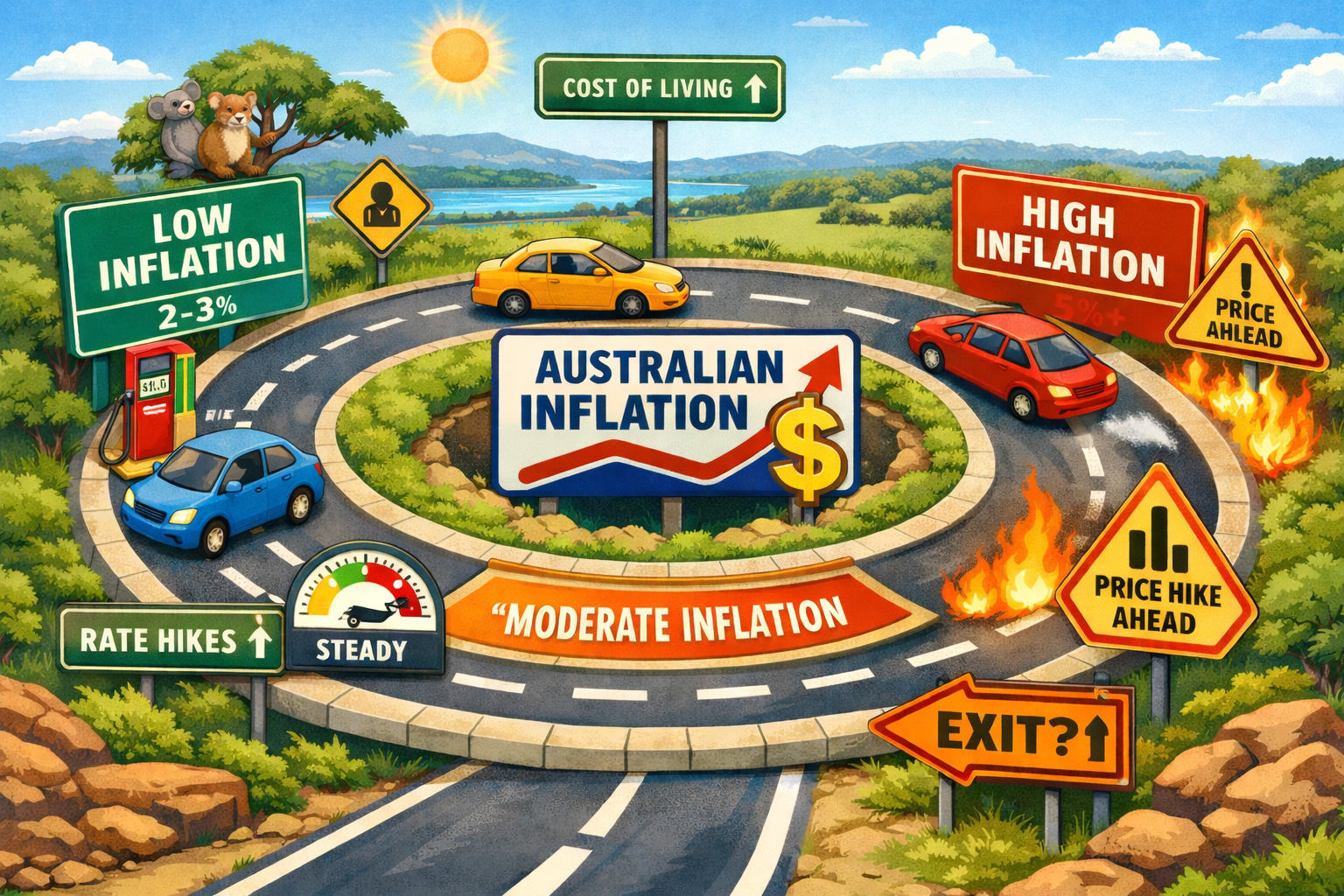
The inflation roundabout
A key contributor to inflation is government spending. unfortunately, limiting government spending has not been a priority for the federal government. by Nico louw.
First published in the MRC’s Watercooler newsletter. Sign up to our mailing list to receive Watercooler directly in your inbox.
Inflation figures out this week are another reminder of the risks we face to our living standards. Inflation is a tax on everyone, eating away at savings and incomes. That's why keeping it under control is so important.
A key contributor to inflation is spending by governments. A Menzies Research Centre report released last year showed a direct link between government spending and inflation, the impacts of which we are seeing today.
Unfortunately for Australia, limiting the impact of government spending on inflation has not been a priority for the Federal Government, which prematurely declared victory over inflation last year. Jim Chalmers and the Prime Minister have repeatedly said that the inflation challenge is behind us and Australia has turned a corner.
The most recent data shows that this wasn't so much a corner as it was a roundabout. Core inflation is now at its highest level since September 2024 and real wages are going backwards.
Faced with questions about the impact of government spending on inflation, Jim Chalmers and Finance Minister Katy Gallagher are fond of pointing out all the 'savings' they have identified. They neglect to mention that these savings are all immediately spent, and then some.
Even worse, some claimed savings aren't even real, they are simply accounting tricks. The biggest saving at the mid-year Budget update in December came from 'capping' the size of the home battery subsidy announced in last year's election. The Government said this 'saved' $6.7 billion, which is very impressive since the original program only cost $2.3 billion.
This impossible saving is possible because, in the mere five and a half months since it launched, the forecast subsidy cost had exploded from $2.3 billion to $13.9 billion. Australians know how to use a generous subsidy when they see one, and why wouldn't they?
The Government hit the panic button and changed the scheme to reduce costs to a mere $7.2 billion, thus 'saving' $6.7 billion compared to the forecast blowout. This $6.7 billion phantom saving allowed Jim Chalmers to claim he had more than offset new spending and improved the Budget by a net $2.2 billion. Meanwhile, Chris Bowen announced the same saving measure as an expansion of the subsidy.
To get Australia out of its productivity slump and get inflation back under control, we will need more than Budget tricks and Economic Reform Summits that lead to nothing.
That's why the Menzies Research Centre has spent the past 12 months developing and publicly releasing comprehensive plans to address the challenges we face, most recently with a report into AI and data centres we published this week.
Our reports have not been intended as partisan attacks. They are of course grounded in Liberal values, but the policies we have proposed can and should be adopted by any political party.
We have:
Developed a costed package to index income tax brackets to inflation, which would both protect workers from bracket creep and act as a much needed constraint on future government spending;
Proposed a suite of low-cost, high-impact policies to improve productivity;
Conducted unique research to draw attention to how NDIS usage varies by suburb and why this needs to be investigated;
Uncovered the growing misuse of the student visa system by non-genuine students seeking work rights in Australia;
Recommended ways to reduce wasteful spending, cut red tape and improve government efficiency; and
Revealed how the union movement has become corporatised, and how this has led to radical changes in IR laws that are reshaping the industrial landscape.
Addressing these issues would be a good place to start if we are to reverse our productivity crisis and keep Australia prosperous.