
Tick the box or lose the tender
The small business share of government contracts has hit record lows. by jarryd williamson.
First published in the MRC’s Watercooler newsletter. Sign up to our mailing list to receive Watercooler directly in your inbox.
Michael Gately runs Trellis Data, a small technology company in Canberra. A deal he was about to land with the Government to deliver Trellis Data’s AI tools collapsed at the last minute because the department in question had already secured that capability as part of a larger contract with Microsoft.
Gately’s experience would be familiar to many small and medium businesses trying to win government tenders. The Government gives you a small job first, to see what you can do. You deliver it well, at a fair price. Then the big contract is advertised and none of that counts. Gately calls it “pilot purgatory”: small businesses run successful pilot programs at a small scale but must prove themselves again and again in subsequent procurement rounds for larger government contracts, only for them to lose out to established multinationals.
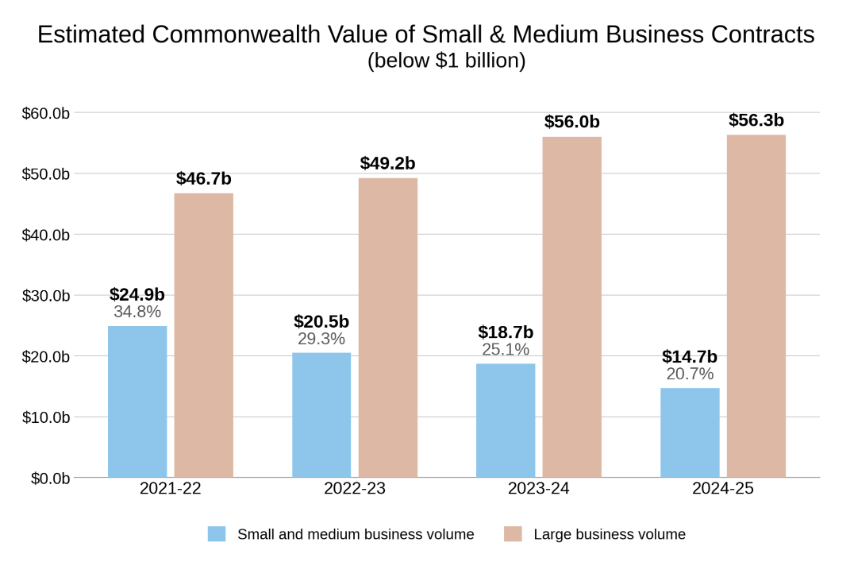
The Commonwealth spent a record $105 billion on contracts last financial year. Concerningly, the share of contracts won by Australian small and medium businesses fell to 14 per cent, the lowest on record and less than half what it was three years ago. That is roughly $10 billion in work that used to go to smaller Australian firms and now doesn't.
This is a broken promise few have noticed. In July 2024, the Government wrote a 25 per cent small business target into its own procurement rules, and it calls the scheme overseeing all this the Buy Australian Plan. The plan is not only delivering barely half of what it promised; it’s also recorded the largest ever overseas share of Commonwealth contracts.
The tender process used to be simple. Businesses were once evaluated on the basis of who could perform the best job. Nowadays, a business must prove its credentials on measures that have nothing to do with price or quality.
A record 14,722 companies collapsed in 2024-25. More than 47,800 have gone under since this Government took office. Energy and fuel bills keep climbing; insurance premiums are up by as much as 30%. Yet the Government's response, in this year's Budget, was to raise taxes on family trusts and capital gains. These are the very structures small business owners use to build something worth having. A government that actually understood small business would make it easier to win public work right now. Instead, the Government has made it harder.
In June, the Federal Government passed legislation that openly discriminates in favour of businesses holding a union enterprise agreement when handing out taxpayer money. Sound familiar? It's the same arrangement that let the CFMEU and its mates in organised crime run rampant over Victoria's Big Build.
Small and family businesses are far less likely to hold a union enterprise agreement, because most operate under an award and have never needed anything more. Master Builders Australia says small businesses make up 98% of the construction industry and generally don't rely on enterprise agreements. So who wins under this new law? Not the tradie who's kept their nose clean for 20 years. The union.
Then there's the compulsory climate test, which is a requirement that suppliers bidding in certain procurement categories such as construction services, furniture and IT submit an environmental sustainability plan with their tender. There is no published formula or weighting assigned to this requirement. That means companies have no idea how much the climate factor counts in the evaluation, relative to price, when procuring officers score competing tenders. It's a gift to any bidder with an in-house sustainability team, but a handicap for the small business owner who's never needed one because they were too busy running their business.
In a bid to stimulate economic development for Indigenous enterprises, Commonwealth agencies must award a minimum share of contracts to Indigenous businesses. While well-intentioned, the benefits of this decade-old Indigenous Procurement Policy have been unevenly distributed. An independent ANU study of the policy's first eight years found half the $7 billion examined went to just 18 businesses, while nearly half the total value of contracts awarded went to firms that only just met Indigenous ownership threshold requirements, a bar the Government only bothered raising from 50% to 51% on 1 July this year. An additional 27% of the total value of contracts awarded went to businesses with unidentified Indigenous ownership status.
On the Government's own figures, the Buy Australian Plan hasn’t just failed. It’s been inverted. The small and medium business share of contracts is at a record low. Overseas suppliers, on the latest count, won more Commonwealth contracts by number than suppliers from South Australia and Western Australia combined. This is the highest overseas share on record.
A plan named for backing Australian business is delivering less work to Australian small business and more to firms that don't operate here at all.
The solution doesn't require a taskforce, a review, or another multi-million dollar rebrand. The Government just needs to make it easier for small businesses to get a cut of this $105 billion yearly contract spending.
This is one thread in a wider project we're running at the Menzies Research Centre on how the Commonwealth spends, tenders and grants taxpayer money, and who actually benefits. Taxpayers are entitled to see where their money goes. We intend to make sure they do.