
Reality check
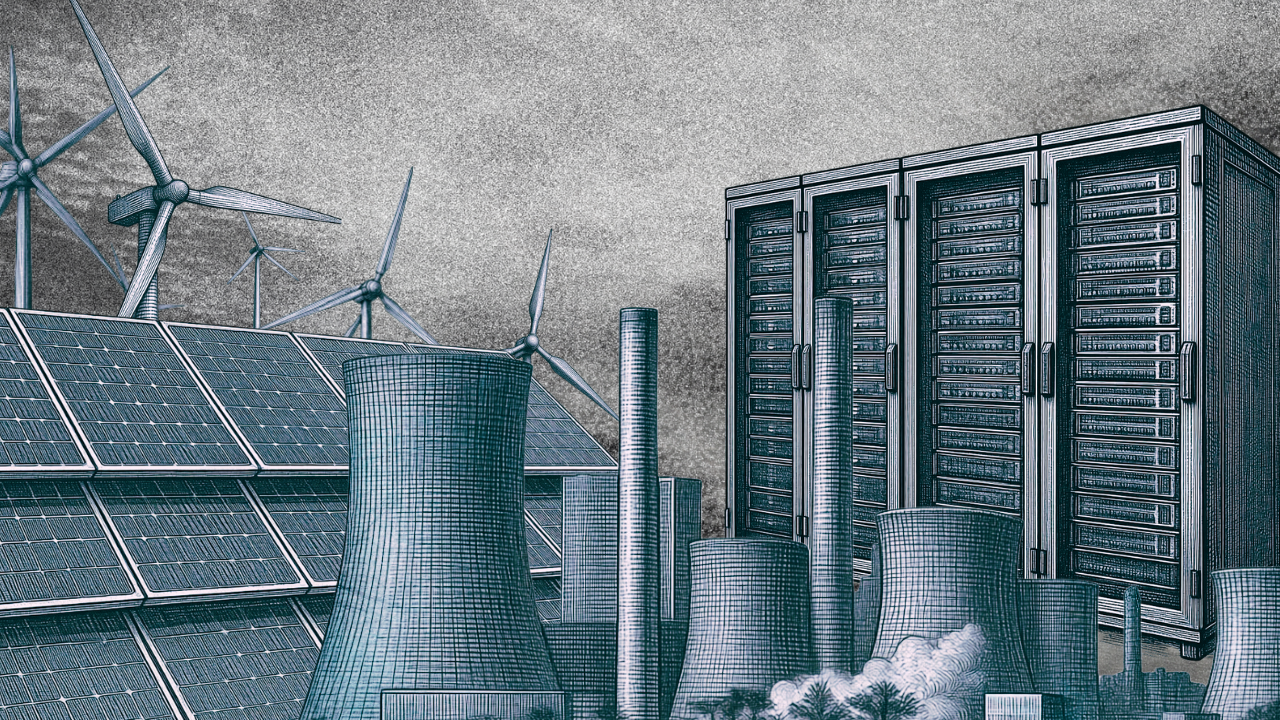
chris bowen made some bold claims in his recent national press club speech. do they stack up? by david hughes.
First published in the MRC’s Watercooler newsletter. Sign up to our mailing list to receive Watercooler directly in your inbox.
On the great empires, the sun famously never set. Chris Bowen carries the same imperial confidence about his renewables empire. But the sun sets on it every evening, and when it does, Australia still runs on coal.
This 'inconvenient truth' is worth remembering when reading Bowen’s speech to the National Press Club on Wednesday. The transcript carries the standard instruction: check against delivery. It needs to be checked against reality. Here are five of the Energy Minister's claims, and what the facts show.
“Coal isn’t baseload power anymore – it’s an unreliable asset.”
As those words left Chris Bowen’s mouth, coal was the predominant source of power across the National Energy Market, powering the lights that shone above him. In the preceding 24 hours, black coal supplied 43 per cent and brown coal 16 per cent. Gas added 3 per cent. Wind delivered 21 per cent and solar 8 per cent, with hydro and batteries making up the rest. The “unreliable asset” carried nearly 60 per cent of the load.
This should not be read as a defence of coal. Rather a defence of the facts, which sits uncomfortably against Bowen’s ideologically driven rhetoric.
The Government's own statistics show fossil fuels supplied over 60 per cent of Australia's electricity in 2025, with coal alone at 42.7 per cent, still the largest single source. But Bowen was selective with his facts, focusing on a three-month period last year when renewables hit 50 per cent. That was the spring quarter, where sunshine was abundant and demand was mild. In the winter quarter just finished, renewables supplied 42 per cent and coal did the heavy lifting through every evening peak.
“Three years in a row. Every single day. A coal outage somewhere in eastern Australia.”
There are around 40 coal units in the national market, and at least one being down for maintenance on any given day is fairly standard for a fleet of 40. But what happens when we apply the same standard to the Minister's preferred technologies? Every night, without exception, there is a solar outage across the entire continent. Every day, the wind drops and turbines sit idle. Coal outages happen one unit at a time. They are mostly scheduled and covered by the rest of the fleet. The sun's outage is total and arrives at dinner time. And when reliability is genuinely at risk, governments pay to keep the “unreliable” coal assets running, as New South Wales did with Eraring and Victoria with Yallourn and Loy Yang A.
“Australia has more fuel today than we had when Iran was first bombed.”
We have more fuel now because we had none then. We barely had any fuel in reserve when the war began — when we really needed it. Australia has not met its international obligation to hold 90 days of fuel stocks since 2012. At the peak of the crisis, Bowen's own weekly updates reported 39 days of petrol, 29 days of diesel and 30 days of jet fuel. Beating the worst week of a crisis really is a low bar which shouldn't be celebrated.
“Data centres are welcome if they bring their own additional renewable energy.”
AI and data centres are the future, and these technologies will drive jobs and productivity gains. Yet the Government is doing everything in its power to resist their establishment in Australia. Ignorant of the fact that technology companies have no obligation to invest in Australia. Now we have a new renewable requirement for technology companies to meet. Most of our competitors have no such requirements.
Germany imposed exactly this kind of mandate, and it has not gone to plan. In 2023 it legislated that data centres be powered entirely on renewable electricity by 2027. That deadline has since slipped to 2030, because it was unworkable. The scheme doesn’t actually require data centres to physically run on green power; instead they can buy certificates that prove, on paper, that an equivalent amount of renewable energy exists elsewhere on the grid. Germany’s scheme is flooded with cheap certificates issued by old renewable generators from across Europe. Cheap prices signal to potential investors that certificate revenue alone can’t justify the cost of building a new wind turbine or solar farm. The upshot is the scheme has not financed a single new wind turbine, while data centres can declare themselves 100% renewable without a single megawatt of new capacity built to supply them.
Bowen has willfully ignored this lesson and is persisting with the Australian version anyway. He told the Press Club he will use Commonwealth legislation to “force” the renewables mandate for data centres in Queensland and the Northern Territory, the two governments that refused to sign up to the impossible dream.
Note the double standard. When Bowen wants something built, renewable projects get subsidies, cheap loans, taxpayer-underwritten revenue, and a demand that networks approve their connections faster. When the industry at the door is AI, the productivity-enhancing investment every other country is chasing, his instinct is to create hurdles: a registration regime, certificate obligations, and standards he has already used to declare one Territory project dead under a law that does not yet exist. Westpac puts the pipeline of data centre investment at $150 billion. The surest way to shrink it is to greet it with a scheme where the economics don't stack up.
“The Cheaper Home Batteries Program has been a remarkable success,” and “Gas is playing less and less of a role in our electricity system as batteries play more and more.”
The Government’s net-zero roadmap factors in the installation of 660 gigawatt-hours of battery storage by 2050, equivalent in raw energy terms to approximately 2.4 petajoules.
As my colleague Nick Cater has pointed out, the cost is unknown, but even with the falling price of batteries, it will likely run into tens of billions of dollars.
A bulk storage diesel tank, on the other hand, the kind we already have at Kurnell or Altona, holds up to 100 million litres of diesel, or roughly 3.6 to 3.8 petajoules of energy.
To put it another way, the entire electricity storage system envisaged by the Government holds less energy than one large liquid fuel tank.
Tellingly, Chris Bowen did not use the phrase ‘net-zero” once during his address. And he even went as far as acknowledging that Labor’s 82% renewables by 2030 target is facing “headwinds”.
Words are cheap to retire; policies are not. Bowen has dropped the phrase because it has become politically expensive, but everything the phrase was invented to justify remains: the targets, the underwriting, the subsidies expanded as recently as Wednesday, a certificate scheme copied from a German experiment that failed.
If the Minister no longer believes the words, he should tell us. If he still believes them, he should say them. What he cannot reasonably do is keep sending Australians the bill for an objective he is no longer willing to name.
If net-zero is no longer worth saying, Australians are entitled to ask why it is still worth paying for.