
Your money or theirs? Taylor forces a real economic contest
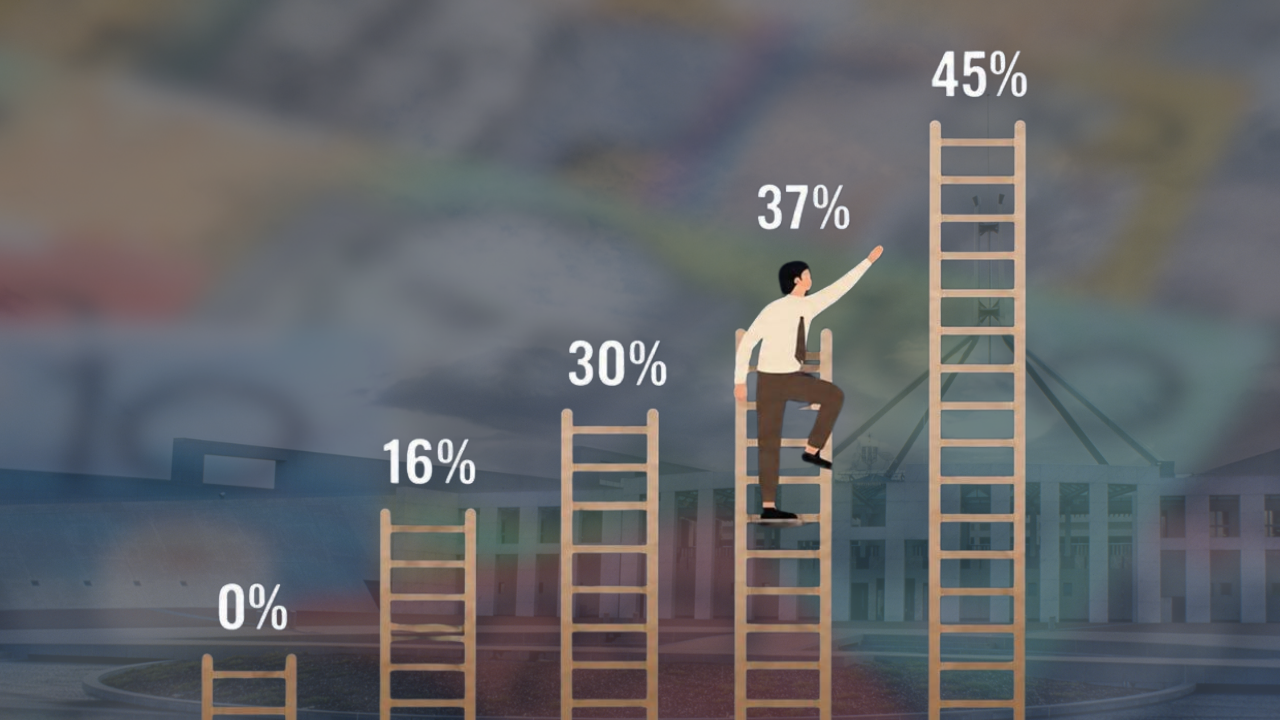
The significance of angus Taylor’s proposal to permanently index personal income tax thresholds is a direct challenge to the quiet expansion of government through bracket creep, and a test of whether serious economic reform is still possible in Australian politics. by nick cater.
Jim Chalmers might have jumped the gun by billing his Budget as the most important and ambitious in decades.
Yet together with Angus Taylor’s Budget-in-Reply, it has set the stage for the starkest economic contest between the Liberals and Labor since the Whitlam era.
The dispute is not merely over tax rates or spending priorities, but a fundamental argument about the role of the state itself: whether prosperity is best advanced by allowing individuals and businesses to keep more of what they earn, or by concentrating ever greater economic power in the hands of government.
Chalmers’ Budget, delivered on May 12, doubled down on the logic that has produed higher public spending, larger bureaucracies, activist industry policy and a growing dependence on government-directed investment.
Angus Taylor’s Budget-in-Reply speech drew an almost perfectly opposing conclusion. Australia’s problem, he argued, is not insufficient government ambition but excessive government absorption of private wealth through bracket creep and expanding public expenditure.
In doing so, Taylor transformed what initially looked like a routine Opposition reply into something far more consequential: the opening salvo in a philosophical contest over the future direction of the Australian economy. Paul Kelly, who has observed federal budgets for more than half a century, called it “one of the bravest calls in history”.
The significance of Taylor’s proposal to permanently index personal income tax thresholds lies not merely in the tax cuts themselves, but in the principle underpinning them. If governments can no longer quietly expand their share of national income through inflation-driven bracket creep, future administrations will be forced to justify spending openly, prioritise more ruthlessly and surrender some of the fiscal elasticity that has allowed the Australian state to grow steadily larger over recent decades.
So while Jim Chalmers’ budget sank faster than a lead balloon, Taylor set up a policy debate that divides Labor and the Coalition on a matter of fundamental philosophical importance:
Is it better to allow individuals to spend their own money in pursuit of their personal ambitions? Or should the government spend it for them in the collective interest of all?
Chalmers’ first line of attack — that ending bracket creep would cost $12.5 billion more over its first four years than Taylor had calculated begged an obvious question: cost who?
Not taxpayers. Indeed, they’ll have $22.5 billion more disposable income after four years on the Coalition’s figure, or $35 billion according to Labor.
The greatest cost will be borne by politicians, who will be forced to spend political capital by cutting spending or adding to the debt.
Nobody close to Taylor would be so foolish as to dismiss this as a mere thought bubble. Taylor has been working through the challenges of reducing the public sector burden for years.
His strategy to reduce government spending to the pre-COVID level of 24 per cent of GDP is to grow the private sector rather than leaning heavily on expenditure cuts, as Malcolm Fraser tried to do half a century ago.
Fraser went to the 1975 election promising “an end to Labor’s tax rip off” by fully indexing personal income tax for three years. “It will make government more honest with your money,” he said. “They will no longer be able to rely on the secret tax increase of inflation.”
Fraser’s inability to reduce inflation broke his resolve, and by the end of his term, indexation had effectively been dropped.
Taylor’s inspiration is not Fraser, but Ronald Reagan, who indexed income tax thresholds in 1985 as part of an extensive program of tax cuts. Far from reducing revenue and increasing deficits, as critics predicted, Reagan’s tax cuts had the opposite effect, stimulating economic growth and instilling optimism that actually increased revenue.
Monica Prasad's account of that period in her 2018 book Starving the Beast: Ronald Reagan and the Tax Cut Revolution shows that Reagan faced circumstances not unlike those faced by the Liberal Party today. Republican support was in the low 20s in the wake of Watergate. An editor at the Los Angeles Times mused, “Who can even imagine a Republican Congress being elected in our lifetime or perhaps in our children’s lifetime?”
Reagan and his advisors concluded they must go for broke. The presidential hopeful should be advocating bold policies that could turn America’s fortunes around, rather than simply relying on the unpopularity of Jimmy Carter.
Polls showed that inflation was the number one concern of the day. Bracket creep (a term coined in this era) was sapping the confidence of workers and business. Reagan was taken with the work of supply-side economists Arthur B Laffer and Robert Mundell, whose novel ideas for solving inflation was championed by Jude Wanniski, an influential commentator at the Wall St Journal and prominent Republican congressman Jack Kemp.
Their thinking departed from the standard monetarist logic which argued that inflation could be controlled by reducing the amount of money in the system, thereby restoring the balance between demand and supply.
The tax movement economists turned that argument on its head. Balance could be restored by producing more goods, not less. When workers were allowed to spend their own money, rather than hand it to government, consumer spending would rise driving confidence and investment.
“To stop inflation you need more goods, not less,” Mundell said in a 1974 Wall Street Journal article. “Keynesians only look at [the] effect on demand . . . They neglect the financing side, aggregate supply and inventory effects.”
The supply-side arguments are neatly distilled in Laffer’s handwritten note on a paper napkin, scrawled over a lunch with Donald Rumsfeld in 1974, now on display at the National Museum of American History.
“If you tax a product, less results,” Laffer wrote, a phrase Taylor is fond of repeating. “If you subsidise a product, more results. We’ve been taxing work, output, and income and subsidizing non-work, leisure and unemployment. The consequences are obvious.”
The supply-side recipe for private-sector growth would also help solve the related problem of big government. Reducing tax revenue would force bureaucrats and politicians to make tradeoffs between competing government programs and incentivise government efficiency.
Reagan took up that theme in his first televised speech as President. “We can lecture our children about extravagance until we run out of voice and breath,” he said. “Or we can cure their extravagance by simply reducing their allowance.”
Unlike Reagan, Taylor will limit tax cuts to bracket creep, initially at least. Yet he is strongly persuaded by the supply-side arguments of the economists who did the intellectual heavy lifting for Reagan.
The truth of Laffer’s observation was reinforced by Chalmers’ Budget decision to remove concessions on capital gains, negative gearing and trusts. It amounts to a tax on entrepreneurial investment, reducing the potential returns on risk. Just as Laffer predicted, we’re about to get less of it. Chalmers’ lack of focus on investment and productivity condemns him to the task of managing decline.
On Sunday, Chalmers painted himself deeper into a corner by claiming that Taylor’s proposal was irresponsible and inflationary. Allowing workers to keep more of their income would “pump the most money into the economy when inflation is already at its highest”.
Yet tax cuts do not increase the amount of money in circulation. They merely change who gets to spend it. Chalmers’ logic is non-sensical. He implies that if the government spends money, it isn’t inflationary, but if citizens spend their own money, it is.
Experience persuades us that the opposite is true: individuals tend to spend their money in the productive side of the economy, stimulating investment, increasing output and building confidence. Governments, on the other hand, are inclined to spend money on unproductive pet projects, siphoning scarce capital to low-return or loss-making projects.
Which, ironically, helps Taylor enormously. Four years of lavish Labor government spending have created a bucketful of projects few taxpayers would miss. Taylor listed some of them in his Budget Reply: climate change bureaucracies, sweetheart deals between governments and corporations, notably in the energy sector, transmission lines, electric vehicle subsidies — the list goes on. Cutting welfare for non-citizens, including subsidies for first-home buyers, will deliver a not-insubstantial fiscal dividend.
Plus, the government has pledged to cut $37.8 billion from the NDIS over four years, enough to pay for Taylor’s tax cuts on its own. Not that Taylor should hold his breath on that one, but hey, you never know.
One thing is clear: Taylor’s proposal to end bracket creep has changed the dynamics of political debate, sharpening the lines between genuine economic reform and the management of decline. One side is intent on raising taxes, living off the fruits of the reform era which increased prosperity and accelerated the growth in private wealth.
On the other side is an economically literate leader, inspired by the vision of a new age of reform, which builds on the intellects and experience of late-20th century reformers by applying their logic to contemporary challenges.
If the old adage that good policy and good places are synonymous holds good, Taylor may yet lead the Coalition to victory in 2028, confounding the critics who say reviving the fortunes of the Liberal Party is too big a challenge to be completed in a single term.
Yet those who have read Kelly over the years will know he chooses his words carefully. Does Kelly apply the adjective “brave” in the manner of Sir Humphrey Appleby in Yes, Prime Minister? Brave in the sense of being political suicidal?
The kind of brave policy that is pursued only by the reckless or the damned?
We can only speculate.
In his 2014 book, The March of Patriots, Kelly mourned the end of the reform era in Australia, and speculated that the shift to managerial, focus-group-led politics was a sign of the times.
Taylor hopes to refute Kelly’s argument by proving that the reform era has merely been taking an extended break. We must hope that genuine reform — the kind based on solid theory and firm liberal principles that gave us the GST and a return to fiscal discipline under John Howard and Peter Costello — is still possible in this attention-challenged, TikToksified age.
