
The economy Labor built: A Budget out of control, leaving you with the bill
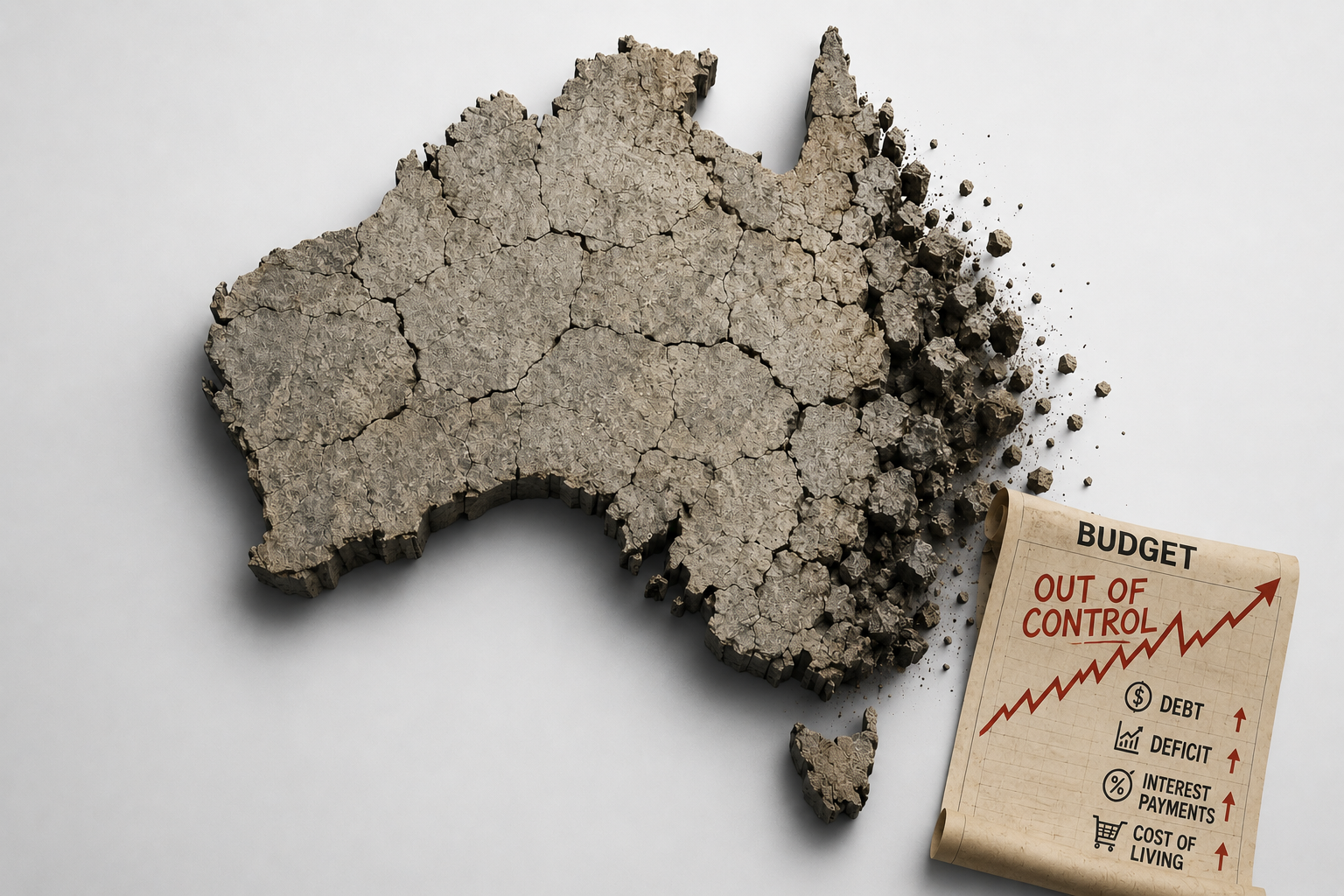
everyday Australians are paying the price for labor’s high spending agenda and its tax assault on families.
This is a an edited transcript of a keynote speech delivered by Tim Wilson to the Australian Chamber of Commerce and Industry on 4 May.
Introduction
Recently I held a roundtable with small business owners in Albury.
At these roundtables the themes are familiar, but this one was different.
The consistent theme was resentment from honest Australians watching their money ending up in the wrong hands: through corruption linked to the CFMEU, through fraud in the NDIS, and through programs where weak safeguards have invited abuse.
When David expressed outrage at the fraud, everyone nodded their heads.
And when that happens, Australians lose faith that the system works for them.
Project Australia
Project Australia is built on democratic principles that we umbrella under the ‘fair go’:
1. We respect each other;
2. Hard work pays off; and
3. Australians are in control of their own lives.
These principles are what propelled our modern nation into one of the most prosperous and confident in the world, and enabled us to be one of the most caring too.
Our first line of defence against misfortune is those around us: Our family, our friends and the local community.
Government is the provider of last resort so it can focus on those most in need.
Australia exists for its citizens, and it is not wrong to prioritise Australia and its security, economy and people.
The moment we become a nation that works for a government that determines our future: the Project is over.
The Albanese government’s own former economic adviser, Alexander Sanchez, recently called out Labor’s attempts to change the structures of our economy and society. He wrote that our open economy is being quietly dismantled, not with great ideological flourish, but by steady accumulation.
This is a deliberate strategy. Big government makes for small citizens. Labor is trying to shrink citizens, and empower themselves.
And when an economy shifts away from earned growth to managed decline it becomes a zero-sum competition through redistribution and resentment.
And we can see this now in the Prime Minister fuelling intergenerational fights over Sunday roasts.
This government regularly engages in politics that plays one group against another — they can’t help themselves — and yet they always act surprised when those groups turn against each other.
It’s a government that knows how to blame but not how to take responsibility.
Menzies warned 80 years ago that any war — a class war, a culture war, a rhetorical war — that sets Australian against Australian is a false war.
The day is coming when those groups will unite — against a government presiding over a weakening economy and a loss of confidence.
The economy Labor built
Shortly after becoming Federal Treasurer, Jim Chalmers, penned an essay arguing “our mission is to redefine and reform the economy and institutions in ways that make our communities more resilient”.
Well, after years of this Government, Australians are entitled to ask: redefined for whom? Who is “our”?
It is the institutions closest to Labor that get the first fill: government, unions, and industry super funds.
Labor feeds them first, because they feed Labor.
This is why Australians are entitled to question value for money for public projects when their honest taxes are finding their way into the hands of dishonest organised crime: something Victorians and Queenslanders are living through the control the CFMEU has over Labor.
They are entitled to question a model in which young Australians are told they cannot use more of their own savings to buy their first home, but fund managers and big business can buy up housing and rent it back to them.
Labor is building a class of Australians dependent on them being in office. This government is not about a better Australia; it is about securing power.
They’ve revealed it in their tax agenda assault on families.
Their capital gains tax applies to everyday Australians, Mums and Dads, but probably won’t to industry super funds nor foreign investors in renewable energy.
Or negative gearing — Labor’s new tax applies to Mums and Dads, but not multinationals or big business.
Or trusts — Labor’s new tax applies to Mums and Dads, but not fund managers.
As CBA chief economist, Luke Yeaman said recently, Labor’s family savings tax agenda will boost revenue by up to $30 billion “but won’t shift the dial on productivity or housing affordability”.
When rules are rigged for those closest to Labor’s power structures, the bill is paid by everyday Australians through wealth transfers, or inflation.
Inflation junkies
Inflation is not a bug in the economy Labor built, it is a design feature: a deliberate cycle to fuel the inflation, tax the inflation, spend the inflation, to fuel the inflation.
Australians are now living the consequences of their inflation habit three times over: declining living standards, with higher taxes and interest rates.
We have higher inflation than any of the major advanced economies. It was high and rising before the Iran crisis. And if the Iran conflict ended today it would persist.
Labor’s inflation is taxing Australians in three ways.
The first tax is inflation itself.
By raising the price of everything more than the wages, it lowers Australian’s purchasing power, which is now lower than when the Coalition left office — and falling.
Since the 2022 election, the average worker has lost around $1,000 in annual real purchasing power due to lower real wages.
The second tax is bracket creep.
While nominal wages might be up, their real wages are down, and it is compounded through tax brackets that aren’t moving.
Since coming to office, the average earner has lost around $2,000 in annual real purchasing power due to bracket creep.
That’s after Labor’s compromised version of the Coalition’s Stage 3 tax cuts. Those tax cuts didn’t even come close to returning bracket creep.
By the time of the December Budget update, just seven months after the election, the tax cuts Labor took to the last election had already been wiped out by the Treasurer’s active inflation agenda.
That’s why, over their time in government, the Albanese government is the highest-taxing government in Australian history. And why personal income taxes, in particular, are at their highest level as a share of the economy ever.
And Labor’s plan is for them to go dramatically higher over the next decade.
The third tax is interest rates.
To date the RBA’s hand has been forced by the government’s active inflation agenda. Tomorrow the RBA is going to have to weigh the Treasurer’s rhetoric versus his Budget realities.
The Treasurer is out there this morning talking spending constraint. There he goes again. The last time he did he boasted savings of $114 billion but spent an additional $223 billion under his breath.
Raising mortgage rates is the one and only tool the RBA has to counteract the Treasurer pouring debt petrol on the inflation fire.
Now 14 rate rises on, the average new mortgage holder has lost around $24,000 in annual real purchasing power due to higher interest payments.
A couple on average incomes with an average mortgage lost $2,000 a year in real wages, $4,000 a year to higher income taxes, and $24,000 a year to higher mortgage repayments.
Australians have lost $30,000 in real purchasing power each year.
Australians feel like they are going backwards, because they are. The resentment to politics is real and needs to be taken seriously.
Jim Chalmers is now actively telling us to break trust, to build trust, so he can target trusts.
The economic follow through is real.
Last financial year, eight businesses collapsed every business hour.
It is clear the treasurer has lost control of the economy. Policy is heading in one direction, the Reserve Bank in the other, and Australians are being caught in between.
That is why there is a sense of hopelessness every time Australians open a power bill, pay their mortgage, or go to the supermarket; or how they feel when they watch the dream of home ownership drift further away.
At first it is disappointment, then frustration, then anger. And it is understandable.
Living standards are sliding because public spending has run ahead of the economy’s productive capacity.
Since Labor came to office, the market sector has absorbed 71% of the additional hours worked in the economy but produced just 30% of the additional output.
That’s a big part of why productivity has fallen 5% under Labor.
Meanwhile Labor expands their control and the growth of institutions that sit between Australians and their own aspirations, and is now setting our economy up for failure.
When we make it harder to start, harder to build, harder to hire and harder to grow, we are not just slowing the economy today, but weakening our future.
The Australian Institute of Company Directors said it all in the title of their recent report “$160 billion and counting: The cost of Commonwealth regulatory complexity”.
Jobs growth in regulatory compliance roles is three times faster than the rest of the market. And in some sectors — 11 times.
The fastest growing industry in Australia is red tape.
An economy that crushes enterprise and energises complexity is not just weaker now, it is more exposed tomorrow.
Because if we are building an economy geared to compliance, administration and procedural overheads in an age of artificial intelligence, we are building an economy around exactly the kinds of roles most vulnerable to technological replacement.
Australia’s economic spirit
This is not inevitable.
Fixing it starts with acknowledging you need to kick the inflation habit.
In a little over a week the Treasurer will stand at the despatch box and deliver his fifth Budget.
The Leader of the Opposition’s Budget Reply will outline our fiscal alternative.
Australia does not need a Budget that manages decline.
A poor nation is a weak nation. And a nation with too much debt loses control of its destiny.
The world has changed. Ageing demographics are reducing labour supply. Alliances are strained and supply chains are fragile. Artificial intelligence, automation and technology will be disruptive.
Adverse events are as regular as storms. They only reinforce the need to be prudent and prepared. Instead, international events are being used as cover, as an excuse.
Budgets are about more than finance. They are an expression of an economic model and the type of society they want to build.
National resilience starts with the resilience of families, community and small business.
That is the economic, structural and moral framework for a good society, and a good economy to support it to spur Australians forward and restore Project Australia — a nation of self-starters who aspire to a home, a family, a business, that are optimists for their future.
Fixing it starts with the Budget. Australia needs a Budget that builds an economy that rewards contribution, restores integrity, and expands opportunity.
We need a Budget that restores living standards by backing self-starters and small business.
We need a Budget that restores Australia’s security to reindustrialise through domestic industry and defence.
Australia needs a Budget that restores honest government through transparency and delivery on promises, to rebuild trust because taxpayers deserve respect.
Their money should be spent honestly.
Programs should be judged by results, not intentions.
Waste, fraud and corruption should be pursued relentlessly, wherever they are found.
And public spending should be benchmarked against outcomes, value and national priorities.
Second, we need to put self-starters back at the centre of economic policy.
That means lowering the barriers to entry.
Reducing needless complexity.
Making it easier to hire, expand and invest.
Reducing taxes.
And creating an environment where more Australians can back themselves and succeed.
Because self-starters are not a side issue:
1. They are where aspiration becomes action.
2. They are where risk becomes investment.
3. They provide the opportunities for work, services, sponsorship and leadership.
And they are where the next generation of growth will come from so Australians can own a home, build savings, start a business, raise a family, and retire with dignity.
The Australian spirit has never been dependent, timid or bureaucratic.
It has been enterprising.
Independent.
Restless.
Confident.
If Labor’s economy could be summed up in an image it is the ‘I heart the NDIS’ logo.
A Coalition vision is the image of the boxing kangaroo.
Strong and fearless.
Forward-looking.
Confident in its own capacity.
We have been that country before.
After the Budget I will outline how we will be again.
But only if we choose an economy that backs Australians — not one that holds them back.
Because the economy we must build is one where Australians are respected, hard work pays off, and people are back in control of their own lives.
Tim Wilson is Shadow Treasurer and Federal Liberal Member for Goldstein.