
The Middle East's overlooked crisis: Christians under siege
The reality of Christians in the Middle East is seldom mentioned, overlooked and dismissed. The cradle of Christianity is quietly emptying, and the world has simply moved on. by Anton issak.
Earlier this year, I distinctly remember making the treacherous walk from one side of the University of Sydney campus to the other. Along this walk, one is confronted with many unpleasant things. From socialists who seemingly believe the private ownership of deodorant should be abolished, and live by that creed, to stalls proudly and unashamedly waving the flag of the Taliban, it seems almost nothing warrants my shock anymore.
My University, after all, is the self-anointed pinnacle of post-Christian, progressive thought; a place no longer bound by the 'archaic' Christian tradition, as they see it. Past the main walkway, I noticed something on a building I have walked by a hundred times; I don't know why it caught my eye that day. But it did, and I smiled.
Anno Domini MCMXXII, a Latin phrase meaning "in the year of our Lord, 1922".
Despite all this noise, even our country's polished, secular institutions, however quietly, still bear a Christian mark. In countries where Christianity is inseparable from the social architecture of the nation, where privilege, peace and prosperity are all encompassing, and omnipresent, one can almost be forgiven for forgetting the reality that faces global christendom.
Christian persecution in the Middle East: overlooked and dismissed
In the lands where Christ himself once walked and the apostles preached, Christianity is systematically being unwoven and crushed. The reality of Christians in the Middle East is seldom mentioned, overlooked and dismissed. The cradle of Christianity is quietly emptying, and the world has simply moved on.
The fact of the matter is this; Christians are on the verge of extinction in the Middle East. At this exact moment in time, the depopulation of Christians from the Middle East has formally been recognised as a genocide. According to US State Department estimates, the Christian population of Iraq fell from 1.2 million in 2011 to 120,000 in 2024. In Syria, the drop was from 1.5 million to 300,000.
The rise of ISIS, and its subsequent slaughterous rule in the late 2010s has further deteriorated the situation. The details that follow carry the texture of ancient antiquity, which makes it all the more shocking that they unfolded within my own lifetime. Within days of its conquest of Mosul, ISIS issued an ultimatum to Christians. Convert, pay an exorbitant and open-ended tax, or face death. Homes of Christians were marked by a large "N" for "Nassarah," a term in the Quran for Christians. And just like that, cities like Mosul and many more that had harboured living, breathing Christian communities since the time of the apostles fell silent.
Facing brutality with faith
The systematic targeting of Christians has become so commonplace across the region that each attack barely registers before the next one begins. Egypt alone tells a story of relentless, grinding violence. My own parents left Egypt during the brutal dictatorships of Anwar Sadat and Hosni Mubarak, which saw the systemic persecution of the country's Coptic Christian minority. They were the lucky ones.
On New Year's Day 2011, a suicide bomber detonated outside a full Coptic church in Alexandria as worshippers filed out from midnight prayers, killing 23. In December 2016, a bomb exploded during Sunday mass at the Botroseya Church in Cairo, killing 29, mostly women and children. Then on Palm Sunday 2017, ISIS struck two churches simultaneously, one in Tanta, one in Alexandria, killing at least 47 people and wounding more than a hundred. Weeks later, masked gunmen boarded a bus of Copts travelling to a monastery and shot passengers at point-blank range, killing 28.
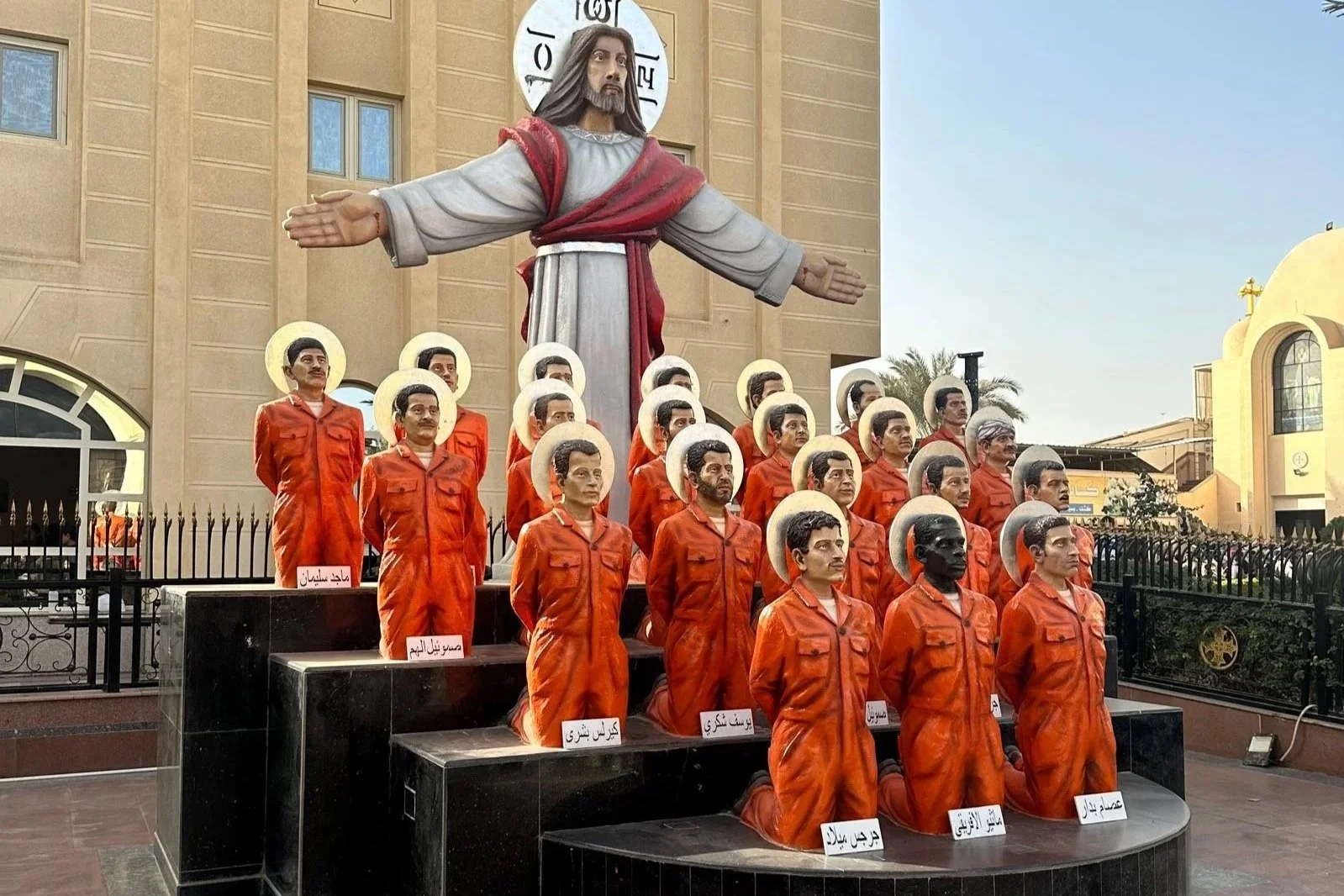
Perhaps most emblematic of this suffering is the story of the 21 Martyrs of Libya. In late 2014, ISIS abducted 20 humble Coptic labourers who had travelled to Libya seeking work to send money home to their families. Among them, almost by accident, was a Ghanaian man named Matthew Ayariga. Matthew had not been a Christian when he first encountered the 20 Copts. But witnessing their calm, unshakeable faith in the face of torture and death, he chose to follow Christ. The group were subjected to relentless torture for weeks on end and told time and time again their agonies would cease if they simply denied their faith. Not one of them did.
When they were finally marched to the shore and forced to kneel on the sand, their lips moved in quiet prayer, "Ya Rabbi Yasou," — My Lord Jesus — in their native Arabic. They were beheaded one by one, on camera; the video in its entirety is still accessible online. Just seven days later, the Coptic Pope, Tawadros II, canonised all 21 as saints of the Coptic Church. In 2023, Pope Francis added them to the Catholic list of saints (I had the privilege of meeting the widow and daughter of one of the Martyrs on my most recent trip to Egypt!).
Existential choices that Middle Eastern Christians must confront
Somewhere in the Middle East tonight, a Christian family is deciding whether to stay or flee, whether to pray quietly or not at all, whether their children will inherit a faith their ancestors carried through two thousand years of history.
And somewhere in Sydney, a university building still reads Anno Domini, in the year of the Lord, unnoticed by the thousands who walk past it every day. That inscription will be walked past a million more times, by a million more people who will never look up.
Meanwhile, in the land where the man it honours was born, lived, and died, his followers are disappearing. The inscription may well outlast them.
Anton Issak was an intern at the Menzies Research Centre.