
Andrew Hastie: ANZAC Oration
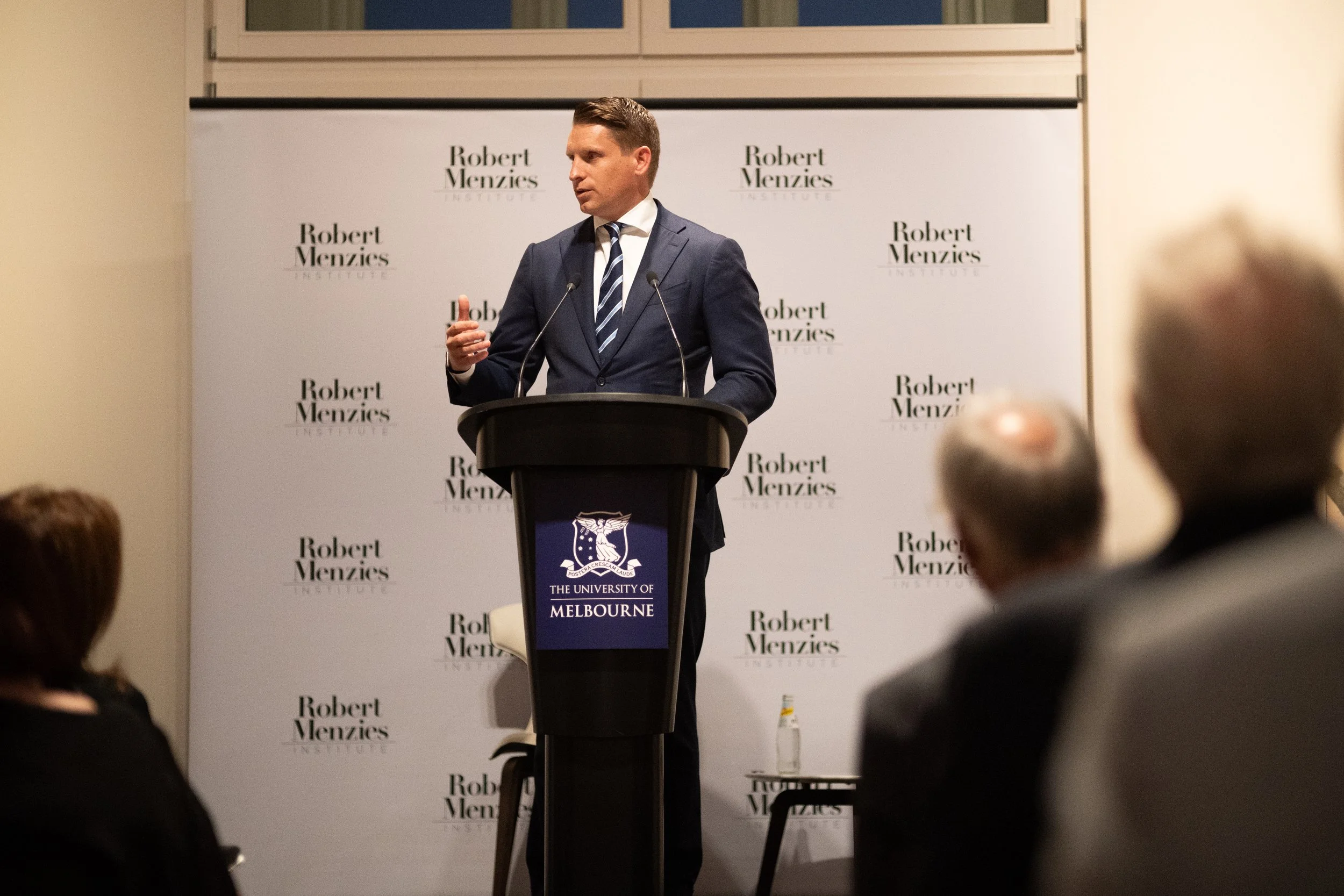
ANDREW HASTIE discusses the strategic thinking that has underpinned australia’s approach to ANZUS and reflects on the future of our alliance with the united states.
This is a transcript of the 2026 ANZAC Oration delivered by Hon Andrew Hastie on 23 April to the Robert Menzies Institute in Melbourne.
Dingo and Eagle
‘Dingo! Dingo!’
The challenge was whispered down the stuffy stairwell of the moving cargo ship.
It was close to midnight, in the Western Pacific Ocean, not far from Guam.
The night was humid and warm.
We were sweating under our helmets, night vision goggles and body armour.
‘Eagle! Eagle!’
The reply shot back up, the American accent unmistakable.
We lowered our weapons, and moved toward one another.
A fist pump and head nod was the quick tactical greeting.
Only minutes earlier, we—the Australian SAS—had fast-roped onto the deck of the moving cargo vessel from U.S. Special Operations Blackhawk helicopters.
As we were coming down our ropes, U.S. Navy SEALs were climbing up the side of the ship on thin caving ladders.
We were the helicopter assault force.
They were the boat assault force.
We started from above, clearing the upper decks.
They started from below, working their way up.
Both force elements methodically cleared the tight spaces on the ship.
Now we’d married up in a stairwell, and had taken control of the bridge.
But that was only part of the mission.
We now had to find the weapon of mass destruction on the ship, and have our weapon specialists render it safe.
The mission would only succeed if we were faster than the enemy. Time was running out.
Earlier that evening, we’d boarded the four Blackhawks on Guam, and flown out over the cool blue ocean at sunset, awaiting orders to hit the ship.
We stayed airborne for so long that we needed to do an air-to-air refuel from a US Air Force Special Operations Command MC-130.
It’s an amazing capability.
Some of you might have seen footage of it used in Iran to rescue downed aircrew this month.
Basically, it extends the flight range of your helicopters.
It looks simple enough: two helicopters hook up to fuel hoses trailing the MC-130 aircraft.
One on each wing of the refueller.
But it’s much more complex when you’re doing it in the dark, over ocean, under night vision.
That night I sat in the door of the Blackhawk—feet hanging over the side—watching the process unfold through my night vision goggles.
I’ll never forget the light spray and smell of the aviation gas as we disconnected from the hose.
It was in that moment that I finally appreciated the size, scale and reach of the U.S. military.
Not that I hadn’t been given plenty of clues.
This moment came during the culminating activity of a massive counter-terrorism exercise that involved senior U.S. civil and military leadership, multiple government agencies, and lots of cool military toys across the Indo-Pacific theatre of operations.
Planes. Ships. Drones. Helicopters.
It was an incredible force package.
A great team of beasts in the sea and sky.
But why were Australians there at the tip of the American spear?
The ADF had been asked to provide a strike force for the exercise.
Normally, Seal Team Six would do this job.
But there was a lot going on in Africa, Afghanistan and the Middle East.
War. Terrorists. Kidnappings.
U.S. Joint Special Operations Command was busy.
So, the Australian SAS got the call-up and being good partners, we happily obliged.
We flew up during the night from Perth.
As the sun rose, we opened the back ramp of the RAAF C-17, released our assault boats, and parachuted after them into the Pacific Ocean.
Once we’d come together in boats, we headed to shore.
It was the first and last time that I’ve cleared U.S. Customs in a wetsuit with helmet, body armour, assault rifle and pistol.
Thankfully my Official Passport stayed dry.
The next week was a flurry of activity as we rehearsed our role in the exercise.
As we approached the final mission, I recall watching my Squadron Commander—Billy the Kidd (as we call him)—brief and hold the attention of the entire U.S. Task Force headquarters.
It was Billy’s mastery of his vocation coupled with a steely confidence that prompted a Navy SEAL officer to turn to me and say: ‘Damn, you guys are good.’
Watching Billy work his magic, I was proud to be an Australian Army Officer.
But I also felt that something was missing.
Yes, we were capable soldiers.
Yes, we could mix it with the best of the United States.
But there was a gap. The balance was off. It was unequal and I think it’s still that way today.
Yes, we might say: Dingo-Dingo, Eagle-Eagle in the bowels of a ship.
That’s even good shorthand for ANZUS at the seventy-five-year mark.
But the partnership in 2012—at the pointy end—felt like a lot of Eagle, and not a lot of Dingo.
Menzies’ two pictures
I think it’s time that we took a long hard look at the assumptions that underpin ANZUS.
And the original vision that Menzies had for the alliance.
So, tonight, I want us to see what Menzies saw.
Because he believed that relations between Australia and the United States offered advantages to both parties that are not ‘quantitatively equal’ but ‘in quality a true benefit in both ways.’
To achieve that, Menzies gave us two great pictures for the ANZUS alliance: animal and spirit.
These images revealed the hard realism, and the moving sentimentality, of Sir Robert Menzies.
First, the animal. Menzies was a hard-headed realist when it came to national security.
As you’ll hear, when he described the ANZUS alliance, he described it as almost a beast, “a species of alliance”, a certain kind of animal.
Second, the spirit. For Menzies had a poetic streak.
You’ll hear some florid passages from his writings about our relations with the United States—even using religious language to describe it as a ‘spiritual alliance’.
His memoirs – ‘Afternoon Light’—was sentimental about the alliance but you can see his strategic calculus if you look hard enough.
You will see that Menzies understood our beneficial quality to come from our military commitments to the United States.
I will discuss how ANZUS, both animal and spirit, have evolved since 1967, and how Menzies’s realism has shaped our strategic thinking about the alliance.
How this realism has led us to operationalise ANZUS through the development of Joint Defence Facilities in Australia, military commitments abroad and our AUKUS agreement to buy nuclear submarines.
This has been driven by an instinct to make our real estate more valuable to the United States, and therefore secure their support in an armed attack against our interests or territory.
The cost or trade-off of this approach has been the loss of sovereign capability and increased dependency on the United States.
I believe we need the visceral fighting animal, and the inspiring spirit of ANZUS, if it is to have a future.
So finally, I will sketch out some reflections on the future of ANZUS and our alliance in light of President Trump, and the direction of the United States government under his leadership.
For we have not seen a President like this before.
It’s not a criticism to say that Menzies probably did not foresee the publication of the ‘The Art of the Deal’, nor the rise of an overtly transactional President like Donald Trump, who operates unmoored from political norms and conventions.
Menzies and Trump came from very different political schools and cultural eras, although they did overlap historically as President Trump was almost twenty years old when Sir Robert left office.
But despite their differences in temperament and style, I do think that Sir Robert was hard-headed and realistic enough to be able to find a way through the unpredictable thicket of words that confront us on Truth Social.
To close, I will suggest that the way forward is a return to Menzies’s hard realism, along with his uplifting inspiration, for matters of national security.
An animal with muscle
Yes, alliances are important.
But so is being a good security partner who can live up to Article II of ANZUS.
That paragraph of ANZUS emphasised that both parties must be building their muscle.
They must develop the means of ‘continuous and effective self-help’, as well as maintain an ‘individual… capacity to resist armed attack.’
Article II expects us to have beast-like strength, and to keep working on it.
That’s why even as ANZUS was signed and ratified, Menzies continued the program of post-war industrialisation that had begun under Labor Prime Minister Ben Chifley.
Of investment in our industrial base, our defence force and our broader resilience as a country.
We need to lift ourselves back to the standard of self-help set by Robert Menzies in the post-war era.
Let me begin this reflection of ANZUS with Robert Menzies’s valedictory Press Conference at Parliament House on the 20th of January 1966.
Sitting in a relaxed unhurried manner in his double-breasted suit, Sir Robert conveyed calm, confidence and warm authority.
All in plainspoken English.
One of the reporters asks him:
“What do you see as your most lasting achievement of these sixteen years?”
On the political side, Sir Robert said that he was satisfied with forming the Liberal Party of out ‘fourteen fragments’ in 1944, and forging ‘a fruitful and constant alliance’ with the Country Party in Federal Parliament.
On internal matters, Sir Robert mentions social services and education—particularly the way his government had invested in universities, opening the way for many young Australians to get a tertiary education.
But it was on external matters, Menzies claimed his greatest achievement: ANZUS. He says:
“…If I were asked which was the best single step that had been taken in the time of my Government I think I would say the ANZUS Treaty because the ANZUS Treaty has made the United States of America not perhaps technically, but in substance our ally. In other words, we have a species of alliance. Don’t hold me to it as a technical expression we have a species of alliance with the United States. And placed as we are in the world, that is tremendously important.”
Menzies didn’t want to be pinned down.
But he revealed the key image, that ANZUS was a species of alliance, a kind of animal.
In my mind, a hybrid beast somewhere between a Dingo and an Eagle.
That’s quite a picture, and there’s a bit to unpack in Sir Robert’s answer but let’s start with the basic facts.
The ANZUS Treaty—signed on 1 September 1951 by our Minister for External Affairs Percy Spender—is a document of no more than 800 words.
It is different from the North Atlantic Treaty Organisation for obvious geographical reasons, but also because it did not include an ironclad security guarantee in the event of an attack on either the United States, Australia or New Zealand.
The ANZUS Treaty text makes that clear with some obvious caveats.
The preamble notes the U.S. military presence in Japan and the Philippines, as well as recognising Australia’s and New Zealand’s military obligations to the British Commonwealth both in the Pacific and beyond.
Those contextual caveats seem to cater solely for the strategic interests and flexibility of the United States.
Afterall, the U.S. was a nuclear superpower navigating the emerging challenges of the Cold War, along with protecting its sprawling global interests.
Australia and New Zealand had much more to gain from the Treaty than the United States, who were cautious about avoiding unnecessary entanglements.
For example, the United States did not want to fall into wars with the British Commonwealth.
This became crystal clear during the Suez Crisis in 1956 and the Indonesian-Malaysian Confrontation in 1963.
Hence the strategic framing about Australia and New Zealand having military obligations to the British Commonwealth in the preamble.
They were our obligations alone: ANZUS was not to be a strategic bridge for the United States into the British Commonwealth.
As Menzies put it, the United States did not want the tail wagging the dog.
That’s why Article IV refers to parties only meeting ‘the common danger in accordance with its constitutional processes.’
Each country had its own internal equities to manage.
I think it is clear that strategic interests—not sentimentality—guided the Treaty.
It should have come as no surprise, therefore, that the United States suspended its ANZUS Treaty obligations to New Zealand over its nuclear-free policy in 1986.
When the U.S. Navy was unable to harbour in New Zealand because of its nuclear weapons, it was the obvious move by the Reagan Administration to suspend its treaty obligations with New Zealand.
ANZUS only lasted thirty-five years for the Kiwis.
You could say it was almost a Trumpian break up.
Maybe the deeper truth is that nothing has changed when making alliances with great powers.
Power and transactions are enduring features, not bugs.
The Kiwis were an early casualty of this reality.
So perhaps the real surprise with ANZUS is that we’ve managed to maintain our alliance with the United States for forty years longer than New Zealand!
But this isn’t because we are more sentimental than our cousins across the Tasman Sea, even though our political rhetoric might sometimes suggest so.
On the contrary, Australian Prime Ministers—regardless of political persuasion—have been generally hardheaded about carefully cultivating our alliance with the United States.
We haven’t missed an opportunity to demonstrate our reliability as an ANZUS partner, as Prime Minister John Howard did after 9/11 – invoking Article IV days after the attacks in New York and Washington, D.C.
All of this has been in continuity with the trajectory set by Sir Robert Menzies in his sixteen years as Prime Minister.
As we learned earlier, Sir Robert called ANZUS his best single step taken during his government.
When he called it ‘a species of alliance’, he was sharing the brute facts of the way the world works.
Nature is red in tooth and claw.
Menzies knew this in his bones, having lived through the two world wars and seen close to 100,000 men and women die defending Australia.
He was no Pollyanna on world affairs.
So that is my first point: I think Menzies’s comment shows a streak of realism that is key to his strategic and political prudence.
But he was also a man of warm ideals, feeling and vision.
He looked upwards, even if history often looked like an abattoir with slippery floors.
A spirit that animates
Menzies reveals his sentimental side in his memoir essay titled ‘Our Relations with the United States of America’.
It’s a broad, winding reflection on our alliance, but here are a few important points.
He opens the essay by articulating the common history shared by Australia and the United States—our cultural heritage, language, religious belief and love of freedom.
Menzies notes that ‘in spite of the great disparity between our population and physical resources, we have a warm place in many American hearts and a respected position in Washington.’
He labours to emphasise that our friendship with the United States is based on a common set of principles and a shared faith in democratic freedoms.
And just in case the reader harbours a cynical heart, Menzies hammers the point home: ‘Our unwritten alliance with the United States is therefore a spiritual one.’
But for all that sentimentality, Menzies lets slip the deeper truth at the heart of our relations with the United States.
It is our military bond, forged in the crucible of war.
He calls it the ‘most eloquent of all facts’ – that American and Australians have fought and bled side-by-side in two great wars, Korea and Vietnam.
And here we see it in stark relief: the foundation of the ANZUS alliance is a military one.
A stone cold truth
Menzies drew on history to set the expectation that Australia will fight alongside the United States in future wars that threaten its peace and security.
That we will make ourselves valuable to the United States by strength of arms against common danger.
Perhaps Menzies was scarred—along with other senior Members of Parliament—by the cold directness of General Douglas MacArthur to Prime Minister John Curtin at the Prime Minister’s War Conference on 1 June 1942.
Although Menzies was not a member of the War Cabinet, I have no doubt that he would have kept abreast of General MacArthur’s utterances.
Let me read an extract of the Minutes to you.
The Commander-in-Chief (that’s MacArthur) conveyed the following to Prime Minister Curtin:
“The United States was an ally whose aim was to win the war, and it had no sovereign interest in the integrity of Australia. Its interest in Australia was from the strategical aspect of the utility of Australia as a base from which to attack and defeat the Japanese …The Commander-in-Chief added that, though the American people were animated by a warm friendship for Australia, their purpose in building up forces in the Commonwealth was not so much from an interest in Australia but rather from its utility as a base from which to hit Japan. In view of the strategical importance of Australia in a war with Japan, this course of military action would probably be followed irrespective of the American relationship to the people who might be occupying Australia.”
I can find no trace of sentimentality in those cold, priggish words from MacArthur.
And perhaps that is why Menzies’s sentimentality gives way to realism when he makes the case for ANZUS.
He lauds the United States for embracing the role and great responsibilities conferred on it by the Second World War—the ANZUS Treaty is proof of that.
Why else would the United States bother with a treaty with two much smaller countries?
Menzies answered the question by insisting that ‘great powers should welcome small friends who think as they do, and who are warmed by the same inner fires.’
Even so, Menzies insisted on the contractual obligation imposed by ANZUS.
As he put it in his own words:
“There is a contract between Australia and America. It is a contract based on the utmost goodwill, the utmost good faith and unqualified friendship. Each of us will stand by it.”
But close friends don’t insist on contracts to govern their relationship, and here we return to the reality of the power dynamic at the heart of the alliance.
This leads me to my second point: the uncertainty at the heart of the ANZUS alliance has led Australian governments to deepen our military relationship with the United States to ensure their support in our time of trial.
Again, the harsh historical record from the Second World War has shaped our approach here.
A Gallup poll in April 1941 asked this question of the American people:
Do you think the United States should send part of our army to Europe to help the British?
79% of respondents answered ‘No.’
The post-war generation of political leaders, Sir Robert Menzies chief among them, knew how hard it was to get the United States into the war until Japan attacked Pearl Harbour in December 1941.
Post-war, Menzies knew that we needed to bring something to the table to make the ANZUS Treaty worth the time and effort for the United States.
That partly explains our combat commitment to Korea and Vietnam, and to the Afghan and Iraq Wars in this century.
It also explains our deep investment in U.S. military technology and supply chains for our defence procurement programs.
So, too, does it explain the establishment of Joint Defence Facilities like Pine Gap in Alice Springs, and the Naval Communication Station Harold E. Holt in Exmouth.
Along with the Marine Rotational Force in Darwin, begun under the Gillard government in 2011 initially with 200 marines and now expanded to 2,500 in recent rotations.
The AUKUS agreement is a natural extension of this strategic logic.
Yes, we will acquire nuclear submarines of our own. But the deeper truth is that we are also allowing a U.S. Navy submarine base to be established in Perth at HMAS Stirling.
Overnight, Admiral Paparo—the U.S. Commander of Indo-Pacific theatre—appeared before the U.S. House Armed Services Committee.
His written submission refers to the deepening of the U.S. force posture in Australia with submarine and bomber deployments, along with the development of infrastructure like fuel dumps and supply chains required for those platforms.
On AUKUS, Admiral Paparo said that a rotational base in the Indian Ocean U.S. submarines was “absolutely essential” and that America “could be ready to operate a submarine squadron – a rotational squadron – out of Australia tomorrow”.
This rotational base in Perth is our hedge against the emerging capability gap that is coming with our ageing RAN Collins class submarines.
But it’s also part of our historic push to make Australia’s defence a strong interest of the United States by giving strategic depth to its military capabilities. MacArthur’s shadow lingers here.
Now we can discuss the individual merits of many of these decisions.
And I’m sure the Afghan War will be debated for some time as we reconcile the long moral costs of our involvement in Afghanistan.
But I want to briefly focus on the strategic trade-offs we have made in doubling down on our alliance with the United States.
For it has cost us sovereign capabilities like a robust defence industry, and our strategic freedom of action in ways that we are now discovering.
A salient example is our liquid fuel security.
At the outset of the Second World War, Australia only had two small refineries.
One in Sydney, the other in Adelaide.
By late 1940, Australia was forced into petrol rationing because of the global war at sea.
In the post-war era, Australia began to build our refining capacity.
Four refineries were built from 1954 to 1956, supplying both the east and west coasts of Australia.
The discovery and extraction of Bass Strait oil in the late 1960s reduced our dependence on imported crude, giving us a degree of energy independence up until the late 1990s.
But after the Cold War, we embraced globalisation and bet long on the dominance of the United States.
And we forgot the lessons applied by the generations of Australians who lived the harsh reality of the Second World War.
Deindustrialisation swiftly followed.
Our advanced manufacturing sector collapsed, along with our defence industry and refining capacity.
We stopped making complex things of value at scale. We lost our industrial teeth.
To use that image of the animal side of the alliance, we began to lose our Dingo as we looked to the Eagle for our defence.
Our industrial base was once a beast—we could build our own light bombers, cars, whitegoods and cargo ships, and pay workers well for it.
Today, our own flatlining productivity and decline in real wage growth is a proof point of our industrial atrophy.
We now import almost ninety percent of our liquid fuels from overseas, and President Trump’s war in Iran is exposing the folly of this national decision that has played out over the last forty years.
That’s why Prime Minister Anthony Albanese is now flying to neighbouring countries to secure our liquid fuel supply.
We forgot the hard lessons of war, and outsourced our security to the United States.
But the consequences go beyond industrialisation.
It’s weakened our hard power.
Our Royal Australian Navy frigates are not deployable to the Strait of Hormuz because we have not kept pace with developing drone and missile technology used in Ukraine and the Middle East.
Even if we send young Australians into harm’s way, we’d be sitting ducks without the intimate support of the U.S. navy.
What’s worse, we’d probably be a soft target for an Iranian drone or missile strike.
The Iranians could send a stern message the same way they have weaponised energy against American allies.
This leads me to my closing point: we need more Dingo to balance the Eagle in our security partnership.
To put it bluntly, if ANZUS is going to continue for another seventy-five years, we need to invest in our industrial base and our defence force.
For the last 30 years, we have neglected our commitment in Article II to develop our means of ‘continuous and effective self-help’ so that we can defend ourselves and our partners.
We must grow our industrial might and hard power.
We must be able to make things of value. We must drill, dig and refine oil here in Australia.
We need U.S. AI hyper-scalers and chipmakers to invest and build here—on our soil—so we can hold them accountable to our sovereign laws, needs and interests.
The AI revolution is coming whether we like it or not.
We can’t sit idle at the end of our submarine cables, and hope powerful oligarchs in Silicon Valley will do the right thing by the Australian people.
We need sovereign data centres built on our red dirt.
We need some Menzian self-help, and soon.
Because the cold cynicism of General Douglas MacArthur has returned once more.
The 2026 National Defence Strategy released by United States Secretary of War Pete Hegseth makes that crystal clear.
In the foreword, Hegseth writes that the United States military will no longer be used to ‘uphold cloud-castle abstractions like the international rules-based order.’
That means the United States should not be expected to guarantee much except its own strategic interests.
President Trump confirms this reality almost every day with his robust messaging about America’s traditional allies.
That means Australia needs to get serious about our own national security.
We need to strengthen our Dingo, so that we can be a better partner to the Eagle.
So that this hybrid beast known as ANZUS looks more balanced.
To do that, we must strengthen our animal side—from our industrial muscle to a defence force with teeth.
But we must inspire the Australian people, too.
About the spirit of our alliance with the United States.
As Menzies did so well, we must speak of what we have done together in the past.
And what we can do together in the future.
If we fail here, ANZUS – the ‘species of alliance’ that Sir Robert Menzies brought into being—will become extinct. And all of us will be less safe.
But I see a different Australia.
One Menzies laboured for.
A nation that has beast-like strength. Beginning with our industry.
And a nation with great spirit. Inspiring Australians and Americans, with what we can do.
So when our friends, and enemies, hear “Dingo Dingo” in the night: they will feel respect and fear.
Andrew Hastie is the Shadow Minister for Industry and Sovereign Capability. He previously served as an officer in the Australian Defence Force.