
Stuck at 0.24%

the only achievement Labor has been able to show for its increased spending of $75 billion on renewables is emissions reduction at a rather paltry rate of 0.24% a year. by david hughes.
First published in the MRC’s Watercooler newsletter. Sign up to our mailing list to receive Watercooler directly in your inbox.
Labor promised an energy policy trifecta. Lower emissions, cheaper power, economic growth. Four years later, all three have run wide on the turn.
Emissions were falling at 28%. Labor has failed to add even a further 1% reduction.
Power prices are up 40%.
And the economy was growing at 4.8%. It's now growing at 1.8%.
Even a pessimist could have believed that it was possible to meet at least one of the three policy goals. But the only achievement Labor has been able to show for its increased spending of $75 billion on renewables is emissions reduction at a rather paltry rate of 0.24% a year.
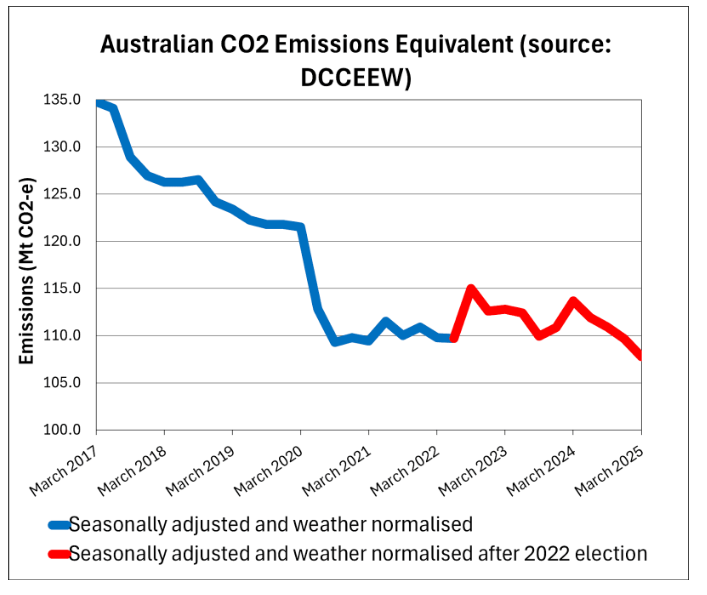
Australia has cut emissions by roughly 28 per cent since 2005 — a rate of reduction stronger than most advanced economies. But nearly all of that progress occurred before Labor came to power in 2022.
Under the current government, emissions reduction has been flat. Reductions now average about 1.5 million tonnes a year, against a national baseline of more than 610 million tonnes. Immaterial by any serious measure.
Yet the Government has adopted new, higher targets that assume the opposite. Its own Climate Change Authority says Labor must now deliver more than 16 million tonnes of new abatement each year to meet its 2030 emissions commitment. Based on the present policy and performance, that is unachievable. As I have previously pointed out, at the current rate, the Government will not be able to achieve its new emissions reduction target until the year 2195.
The Government’s centrepiece is the push to 82 per cent renewables by 2030, with more than $75 billion committed to support that ambition. But the physical build-out has stalled. Wind projects are delayed, solar growth is flattening, transmission corridors are behind schedule and storage remains insufficient to cover gaps in generation.
When those gaps appear, governments are forced into alternative action. Every major reliability scare since 2022 has produced the same response: extend coal and gas. The ‘renewables only’ approach of Federal and state governments has, counterintuitively, led to a shift back to coal and gas. Born from necessity.
Faced with the prospect of blackouts, New South Wales negotiated to keep the Eraring coal plant running until at least 2027 after the market operator warned of supply shortfalls. Victoria locked in agreements to keep Yallourn and Loy Yang A coal plants operating beyond their planned retirement dates. South Australia extended the Torrens Island gas plant to cover reliability issues created by delayed transmission. Queensland’s new roadmap keeps the state’s coal fleet available well into the 2040s.
These governments have all reached the same conclusion: a renewables-only system cannot guarantee security or supply.
In 2023, when energy policy began to fall apart and prices rose sharply, the Commonwealth moved quickly to cap the price of coal and gas. Within months, the Government was compensating the same generators it had just restricted. Close to $2 billion went out the door. Not one dollar built new capacity. Taxpayer dollars kept coal and gas running because the system could not yet cope without them.
A similar pattern has emerged under the Safeguard Mechanism policy, which forces large industrial facilities (such as mines and cement producers) to cut emissions each year. If they cannot, they must purchase credits to offset them, blowing out their cost base that inevitably flows through to consumers. Soon after, the Government created a $400 million dollar fund to subsidise those same companies so they could comply. On one side they pay for the policy. On the other side they are paid by it.
It is exactly what Ronald Reagan warned about: “If it moves, tax it. If it keeps moving, regulate it. And if it stops moving, subsidise it.” Coal, gas and industry have moved through all three stages because energy policy has relied on interventions, not on design. This same approach means we are now also subsidising smelters to compensate for the taxes and regulations that have led to their demise.
The now-defunct Energy Security Board offered a clearer alternative. It recommended a technology-neutral capacity mechanism that pays any generator for being available when the system needs firm supply. Coal, gas, hydro, storage and eventually nuclear would all compete on the same terms. Consumers would pay for reliability, not for ad hoc crisis responses.
Had that mechanism been adopted, governments may not be negotiating last-minute life support for coal plants or writing blank cheques to companies suffocated by policy. The market would decide which technologies can deliver firm power at the lowest cost and ageing units could retire only once genuine replacements exist.
A policy built on exclusion has ultimately entrenched the technology it sought to eliminate.
The contrast with what works could not be clearer. Allow gas to do its job. Lift the ban on nuclear power. Put in place a genuine capacity market that pays for firm supply and lets technologies compete on cost and reliability. Under such a system, coal would retire when replacements stand ready, not when political timetables declare it so.
The facts are not ambiguous. A renewables-only strategy has not delivered lower emissions. It has not delivered lower prices. And it has not led to the extinction of coal. It has produced the opposite.
For the many voters who want lower emissions, consider this. On the current trajectory, the Labor Government will beat its emissions reduction target in the year 2195. Energy Minister Chris Bowen will be 222 years old if he lives to see the day.
