
Spend now. Pay later.

Labor’s reliance on bracket creep incentivises poor budget management. ending it would limit the government’s ability to make long-term spending promises without explaining how they’ll be paid for. by Nico louw.
First published in the MRC’s Watercooler newsletter. Sign up to our mailing list to receive Watercooler directly in your inbox.
Welfare spending significantly exceeding forecasts, with no appetite to attempt even the smallest reforms to make it more sustainable.
A broken promise to lower energy bills, papered over with new taxpayer subsidies.
Forecasts for productivity growth downgraded, which means lower living standards and reduced tax revenue to fund essential services.
The response? Spend more in the short term and pay for it with bracket creep in the long term. An unsustainable ‘spend now, pay later’ strategy that leaves future generations to foot the bill.
I am of course referring to the UK Labour Government’s Budget, handed down last week.
It sounds all too familiar.
There is, however, one notable difference to Australia.
Media and political attention in the UK is centred on the Government’s decision to extend an existing freeze on income tax thresholds, which are usually indexed to inflation, for another three years. This is by far the biggest tax increase in the Budget, raising the equivalent of $26 billion through bracket creep.
The decision to freeze income tax brackets for longer is being rightly condemned across the political spectrum as a tax on millions of working people. News websites feature tax calculators so individuals can see exactly how much more they will pay every year.
They would be shocked to learn that this happens in every Australian Budget, every year. But in Australia there is no criticism. No media interest. No calculators.
Imagine the outcry if the UK had instead chosen to end indexation for good. Announcing that every British taxpayer will face a tax increase every year, forever! Yet this is the system we tolerate in Australia, without a hint of protest.
Last week's disastrous inflation figure, coming in at 3.8%, was a reminder of the cost that bracket creep imposes on Australian workers. That level of inflation over a financial year would see an average full-time worker paying $350 more in tax due to bracket creep.
As Shadow Treasurer Ted O’Brien pointed out last week, bracket creep is part of Labor’s Budget strategy. The Budget projections rely on half a trillion dollars of higher personal income taxes over the next decade — and this still doesn’t deliver a surplus. Parliamentary Budget Office figures show that, if bracket creep was returned to taxpayers, the Budget would remain deep in deficit.
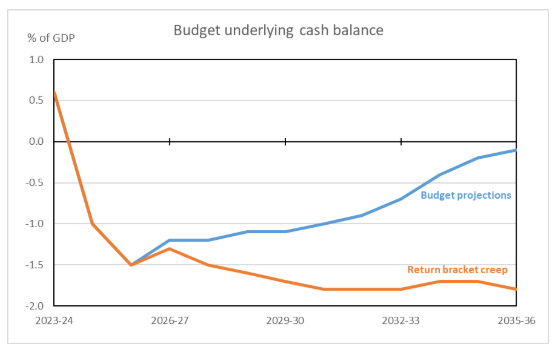
Source: Parliamentary Budget Office figures.
This strategy of relying on bracket creep incentivises poor Budget management. Think of it as having a credit card where the limit increases every year, even if you overdraw and make no repayments. Jim Chalmers has taken this strategy to extremes, increasing the size of the public service by 25% in just three years and blowing a $250 billion revenue uplift, while using the projections above to pretend everything will be ok.
It seems counterintuitive, but the best way to stop this behaviour is to end bracket creep and the automatic tax revenue it delivers. This would force governments to be honest with voters by limiting their ability to make long-term spending promises without explaining how they’ll be paid for. The UK Budget was terrible, but at least the Government had to be up front and explain to voters that their taxes would be going up to pay for higher welfare spending.
As we showed in a report earlier this year, Stop the Creep: Restoring fairness to Australia’s tax system, ending bracket creep is a fair and affordable reform that would disproportionately benefit young people and low- and middle-income earners.
In the coming years, let’s hope we see Australian news stories with calculators showing workers how much of their income they’ll get to keep each year as a result of this much needed reform.
