
Payment for past sins
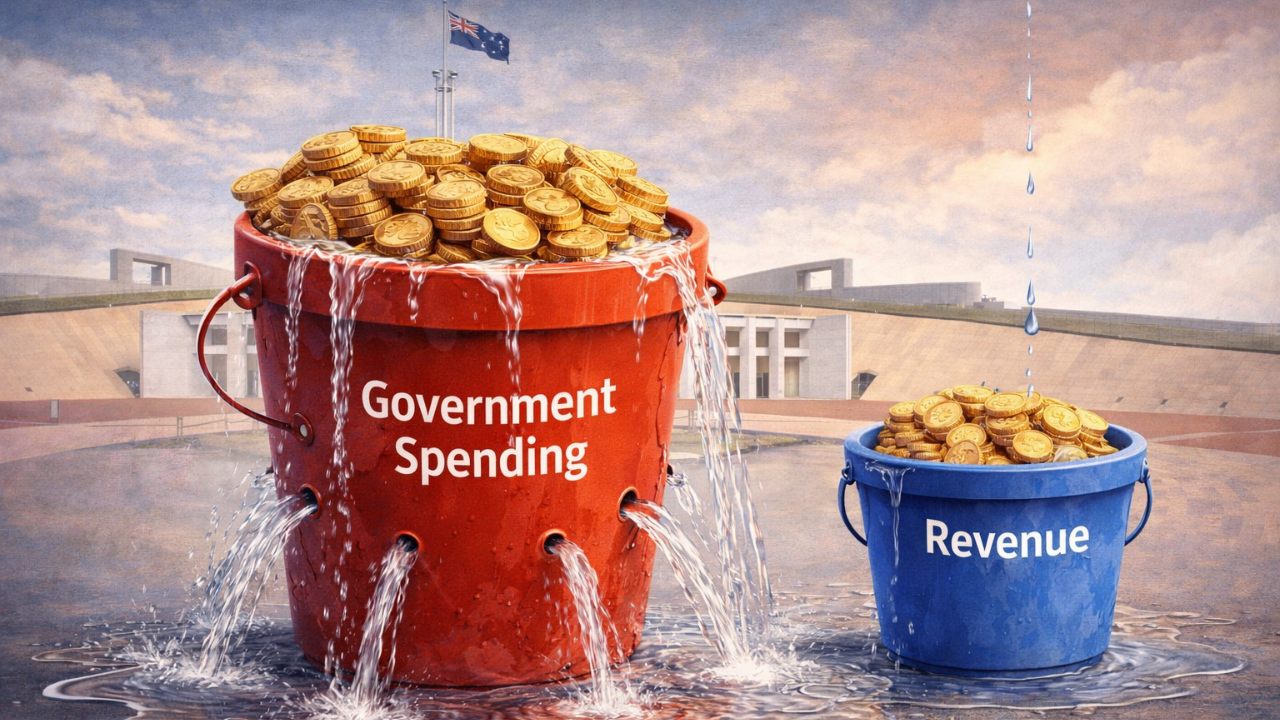
the Government should be focused on debt reduction. Instead, they are increasing spending at a faster rate than revenue can support. by david hughes.
First published in the MRC’s Watercooler newsletter. Sign up to our mailing list to receive Watercooler directly in your inbox.
With the war in Iran now pushing up global oil prices, the Australian Government has found an external factor to blame for rising inflation and a likely deterioration in the Budget.
But well before petrol prices started to rise, Australia was already struggling.
Australia entered 2026 and this period of global instability with gross debt of about $1 trillion and net debt of about $620 billion. These figures are too large for most Australians to process. Put another way, net debt amounts to roughly $22,500 for every Australian.
For a nation in this predicament, you would think the Government would be focused on debt reduction. Instead, they are increasing spending at a faster rate than revenue can support. Last year, the Commonwealth spent $731 billion and this year it will spend $777 billion. This is not simply a nominal increase — it also lifts spending as a proportion of GDP from 26% to 27%. While government revenue remains stagnant at 25.5% of GDP.
The Government's problem is twofold: it has allowed spending to surge while failing to deliver meaningful growth in output per person.
Let's look deeper on this second point first. GDP per capita is a rough measure of how much the economy is producing for each Australian. It matters because headline GDP can rise even while Australians go backwards on a per-person basis. Anthony Albanese is the first Prime Minister to preside over a reduction in GDP per capita since the ABS started tracking their current series.
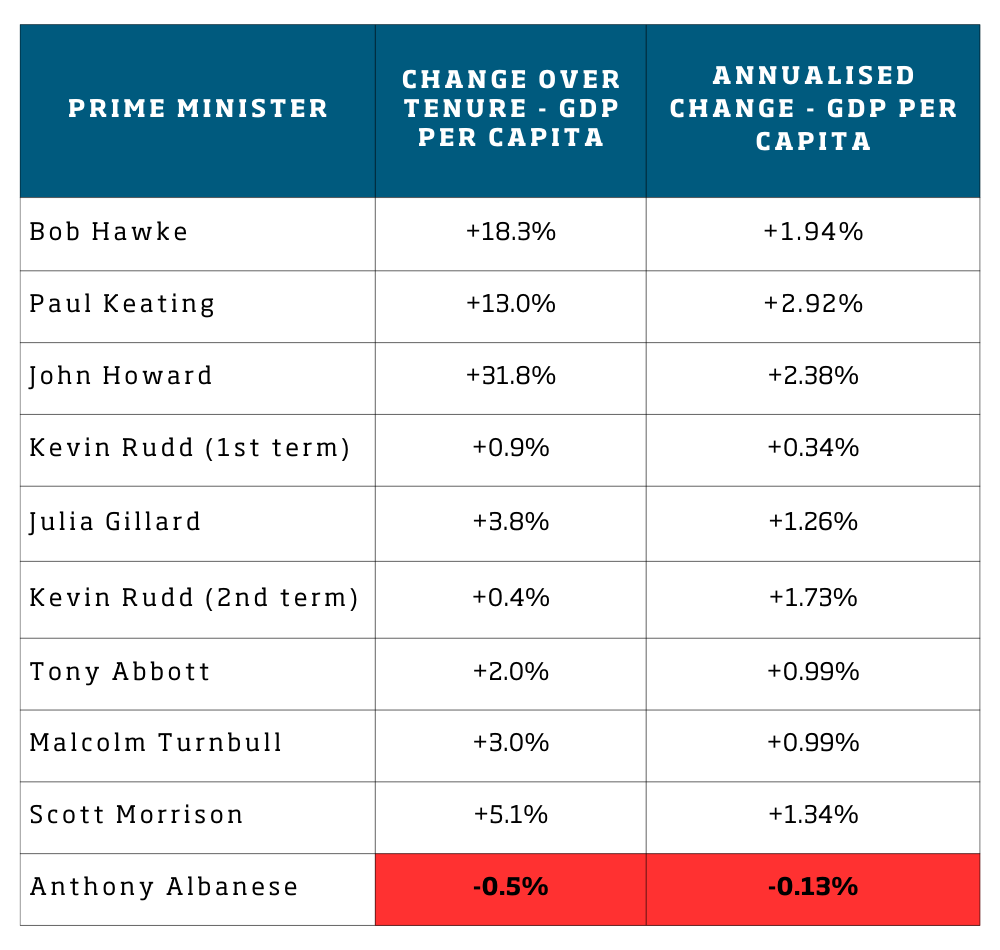
As the above table shows, even Kevin Rudd who faced a global financial crisis has a better record on growing the economy than Anthony Albanese. Albanese's failure to create a more prosperous Australia is the combined effect of many factors: increasing government spending which has fuelled inflation; more regulation and regressive industrial relation changes which have impacted productivity; and the growth in the size of the unproductive government sector. Of course, there have been wars and external factors at play but that is something every government over the past 30 years has been forced to contend with.
It is worth looking closer at government spending. In raw terms, Commonwealth payments were $478 billion in 2019. In 2026 they are forecast to reach $777 billion. That's an increase of almost $300 billion in seven years. A jump of that scale is only sustainable if the economy and revenue base are growing fast enough to carry it.
With gross debt now above $1 trillion, spending should be growing no faster than revenue, and ideally more slowly. But the opposite is happening.
This year, the Government forecast $735 billion in receipts and will spend $777 billion. In other words, revenue represents 25.5% of GDP but the Government will spend at a higher rate of 27% of GDP. To demonstrate the extent to which the government has grown, the Whitlam Government restrained spending to around 18-19% of GDP.
Young Australians should be the most concerned by our current budget predicament. They will face the double burden of supporting an ageing population while carrying the weight of government debt accumulated long before they reached their peak earning years. They will not just be paying for today's spending. They will be paying for yesterday's too.