What's driving populism?
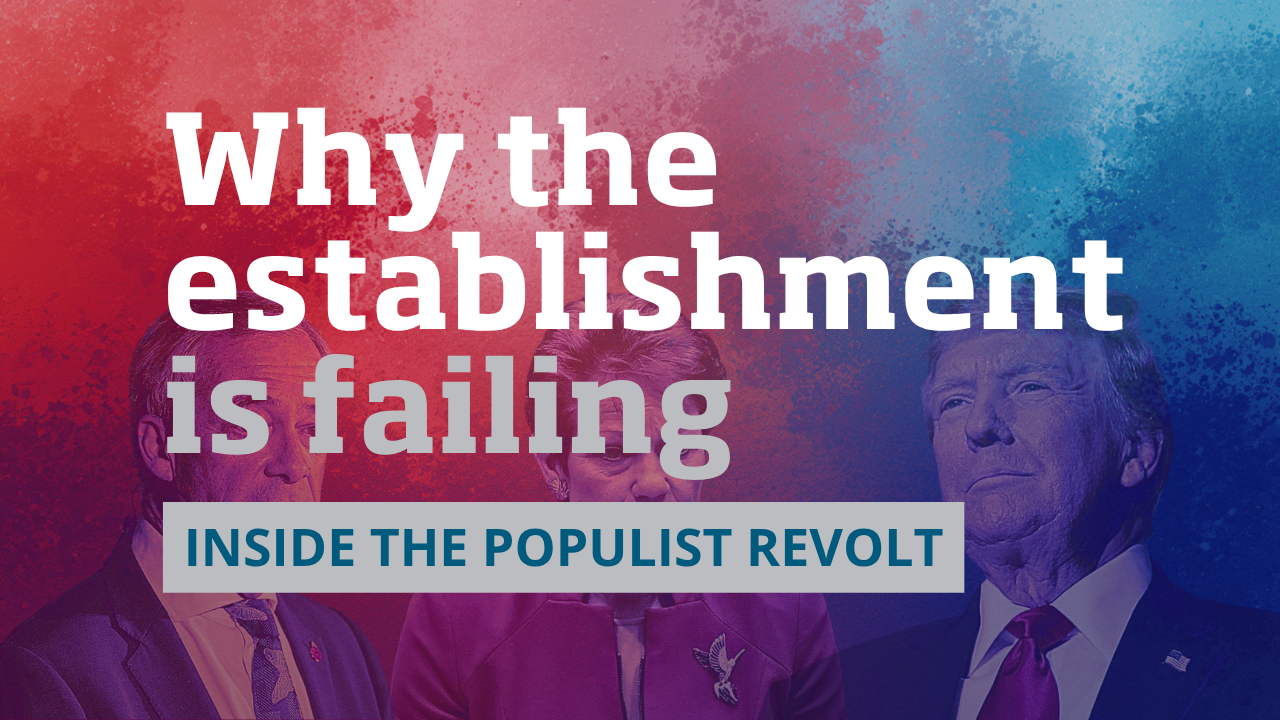
voters are doing everything right. but they still can’t get ahead. by david hughes.
First published in the MRC’s Watercooler newsletter. Sign up to our mailing list to receive Watercooler directly in your inbox.
Populism is one of the most overused words in politics and one of the least understood. Too often it’s little more than an insult: shorthand for views respectable people aren't meant to hold, or a way of brushing aside voters who have lost patience with the establishment.
That isn't a serious way to make sense of what is happening across the Western world.
Last week at the Menzies Research Centre, I sat down with the strategist Isaac Levido to talk through the political shifts now reshaping Britain, Australia and other democracies. The point was not to cheer populism on, nor to condemn it. Simply to provide the audience with a better understanding.
Populism is not a traditional ideology. It can be right-wing or left-wing, nationalist or protectionist, anti-corporate or anti-immigration, and sometimes several of these at once. What populist movements share is not a coherent platform but a claim: that they represent ordinary people against a self-serving establishment.
The social contract is broken
A recent survey across 31 countries, found that 57 per cent of people believe their country is in decline. 56 per cent say society is broken. 47 per cent want a strong leader willing to break the rules. In the established Western democracies the numbers run even higher.
Voters aren't just asking for different policies on tax, migration or energy. They are asking a deeper question: are the people running our institutions competent, candid, and on our side?
For decades, voters were sold a straightforward bargain. Work hard, pay your taxes, obey the law, save for the future, and you would be rewarded. You could afford a home. Your children would do better than you did. Public services would be worth what you paid for them.
For many people, that contract hasn't been honoured.
We’re doing everything right but falling further behind
Australia's real per capita household disposable income grew by just 3.5 per cent over the last decade. The OECD average was 18.7 per cent. The United States managed more than 20. We have fallen further behind comparable economies than at any point in living memory, while paying more in tax than at almost any time in our history.
People feel they are doing everything right, working, paying their tax, paying their bills, and still they cannot get ahead.
In our discussion, Isaac pointed out that technology is sharpening these frustrations. In their private lives, Australians have grown used to problems being solved in seconds. From Uber, to Amazon and banking through a phone app. The private sector keeps solving problems that once seemed intractable, and ordinary people feel the benefit.
But it seems government has moved in the opposite direction. Government costs more, delivers less and struggles with the basics. If technology can make life easier almost everywhere else, voters are entitled to ask why government keeps becoming more expensive and less effective.
Voters need leaders to stand for something
On top of this, there is a conviction problem. Voters increasingly suspect their leaders stand for nothing in particular.
The Albanese Government's new taxes are the latest example. Labor ruled out new taxes on capital gains before the election only to break that promise once in power. It then justified the measure on grounds of intergenerational fairness, a concept they previously spoke little about. Voters draw the obvious conclusion. If the problem was as serious as you now claim, why didn't you tell us before polling day? And if you're walking it back, did you ever really believe in it?
Voters don't expect perfection but they are drawn to conviction. They can accept difficult arguments when leaders are honest about the trade-offs. Families make trade-offs every week. What they won't forgive is being treated as though they can't handle the truth.
This is why the “small target” approach is so corrosive. It may win an election. But a party that arrives in office without having argued for anything has no mandate, no public equity, no room to manoeuvre. The moment it tries to do anything difficult, voters reasonably ask why they weren't told before.
Repairing the social contract
The lesson for Liberals is not to mimic every populist slogan. Many populist policies aren't liberal. Some are protectionist. Some are anti-market. Some would weaken the institutions they claim to restore.
But it would be a far greater mistake to dismiss the voters drawn to populist parties. Most of them aren't extremists. They are people who feel the established parties stopped listening.
The answer for the Liberals is rather simple: restore the bargain. That means lower, simpler and fairer taxes so effort is rewarded. It means spending restraint so government stops fuelling the cost-of-living pressures it claims to relieve. It means a housing system in which young Australians can realistically aspire to own a home. Migration calibrated to housing, infrastructure and services. Energy policy grounded in reliability and affordability rather than ideology. And basic public services that actually work.
Above all, it means giving Australians a stake in the country they live in. And helping to recreate the country they remember but feel is slipping away.
Winning back the right to be heard
Populism feeds on the feeling that ordinary people have lost control of their country and their lives. The answer is not to scold them back into line. It is to rebuild the conditions in which they feel secure, respected and heard.
Established parties aren't just at risk of losing votes. They are at risk of losing the right to be heard. Winning that right back will take humility, a willingness to listen before labelling, and the courage to make big conviction arguments again.
Populism is a warning. A healthy democracy ignores it at its peril, but nor should it surrender to it. The right response is the one good politics has always offered: understand the grievances, tell the truth, fix what is broken. To hear more analysis, you can watch or listen to my discussion with Isaac.