Trading places
On investment, GDP, mining, inflation, and wages, Canada used to lag Australia. Now they’ve swapped places. by david hughes.
First published in the MRC’s Watercooler newsletter. Sign up to our mailing list to receive Watercooler directly in your inbox.
Nobody mistakes Justin Trudeau for a friend of business. He ran Canada for nine of its past 11 years of progressive government, spent, taxed and regulated with enthusiasm, then quit under pressure from his own party.
By rights, Canada should trail Australia, which has had only four years of a high-taxing and spending Labor government. But it doesn't. On investment, GDP, mining, inflation, and wages, Canada has overtaken Australia since Trudeau left, which suggests the problem here is not how long the progressives have been in office but how hostile to business they have been while there.
Consider the following:
In 2022, Australia attracted US$62 billion in foreign investment ahead of Canada’s US$53 billion. By 2025 Canada attracted US$67 billion and Australia US$35 billion.
In a global survey that asks mining executives where they would invest, Western Australia ranked 2nd in the world in 2018 and Ontario 20th. In the 2025 survey, Ontario is 2nd and WA fell to 6th. On the quality of government policy, WA has fallen from 5th to 13th and Ontario has risen from 13th to 5th.
In 2022, Australia had $83 billion worth of committed resources and energy projects. Today it's fallen to $62 billion. Canada's new Major Projects Office has had around $120 billion of projects referred to it in little more than a year.
Australia taxes new business investment at an effective rate of 28.6% and Canada at 13.7. Royalties make the gap wider. Canadian provinces tax a mine's profits, while Australian states tax its revenue, so a mine here pays even in a losing year.
On wider economic measures, Canada also leads. Their underlying inflation is 1.9%. Ours is 3.6% and has sat above the Reserve Bank's band for more than a year. Canadian real wages rose 1.3% last year and productivity 1.%; in Australia both fell. The Reserve Bank has lifted interest rates five times this year, and the Bank of Canada once.
Australia’s Treasurer blames inflation on wars in the Middle East and Ukraine and the hangover from COVID. Events to which Canada must have been immune.
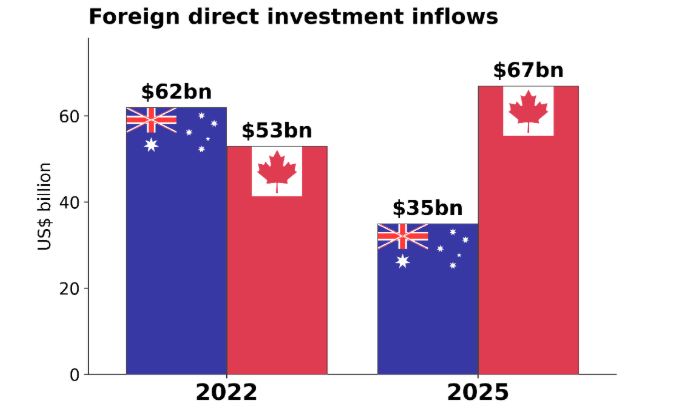
Source: UNCTAD, World Investment Report 2023 and 2026.
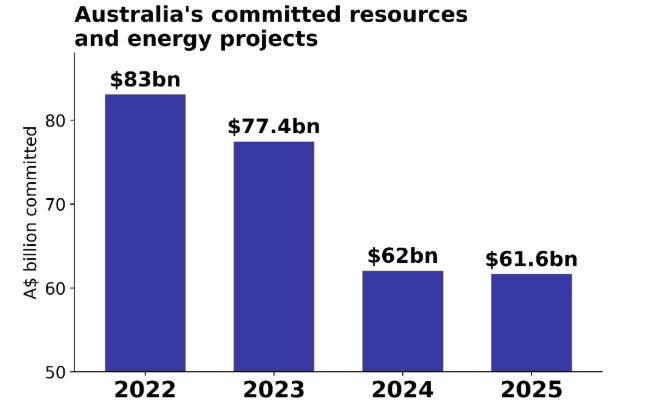
Source: Department of Industry, Science and Resources, Resources and Energy Major Projects, 2022 to 2025. Vertical axis starts at $50 billion.
The difference is what Australian governments have done over the past decade to make business investment and mining harder. Environmental approvals take years, and government-funded activists then challenge projects in the courts. When a mine finally gets off the ground, often 15 years after the deposit was found, it meets higher royalties, rising energy costs, 10 regressive changes to workplace law since 2022 and climate and emissions policies. Now there is a push to add another barrier.
Activists, the Greens and a growing number inside Labor want the fuel tax credit scrapped. 322 Labor branches have called for the change in policy. The credit refunds the fuel excise a business pays on diesel used off public roads by tractors, fishing boats and mining trucks that never touch the roads the excise was meant to pay for. Of 182,000 claimants, four in five are small businesses. The typical claimant is a family farm or a trucking firm, not BHP.
A tax changes behaviour only where there is something to change to. There is no electric tractor on sale that can do the work of a diesel one, no electric commercial fishing fleet, and the first battery-powered mining trucks are still being trialled. BHP says they would need to stop up to eight times a day to charge. Remote mines in WA, with no grid to plug into, draw 80 per cent of their electricity from diesel generators, so a battery truck charged there still runs on diesel.
Australian farms run on diesel because electric tractors only work on small hobby farms.
Remove the fuel tax credit and emissions do not fall, because a tax only changes behaviour when there is something to switch to, and there is simply no alternative to diesel. The diesel still gets burned. The only thing that changes is that the Commonwealth collects $10 billion a year more in tax from the industries that feed and supply the country, at a rate of $198 a tonne of carbon. Our report, A Carbon Tax by Stealth, costed it: one of the highest carbon taxes in the world, eight times the $23 carbon tax Julia Gillard imposed in 2012. Yet, even Gillard spared farmers, fishers, foresters and trucks on public roads.
The push to scrap the credit is run in the name of the miners, yet the Parliamentary Budget Office's figures show the credit is worth a tenth of the income tax mining pays. For transport, it’s almost two-thirds, while in agriculture it's three-quarters. For a farm using 80,000 litres a year, abolition is a $42,960 bill against a forecast profit of $133,000. For the exporters who sell at world prices, it is a cost that cannot be passed on. The tax would fall hardest on the people with the least room to absorb it and no other fuel to turn to.
In August 2010 Julia Gillard said, “There will be no carbon tax under the Government I lead.” Before the 2022 election, Anthony Albanese went further: “There will be no carbon tax, ever.” This would be a carbon tax in every respect but the name, and it would be paid first on farms and in trucking yards. The credit is a refund of tax already paid. Removing it, as 322 Labor branches have voted to, would be a new tax on the production of food, minerals and timber, and another promise broken.
Australia continues to erect new barriers to business and investment while the rest of the world opens up. Ten days ago British Columbia, a mining province, elected a Conservative government for the first time in nearly a century. The governing party had called a snap election two years early; the Conservative leader had held the job for a few weeks. He won two-thirds of the seats on a platform of cutting spending to fund tax cuts, balancing the budget and making British Columbia the fastest place in North America to approve a new mine.
Why would an Australian mining company invest here when Canada and others actually want mining investment and have adjusted their policy settings to welcome it? It is probably only loyalty to this country that keeps BHP and Rio Tinto investing billions here, and loyalty wears thin when the returns are better elsewhere.
The Menzies Research Centre will have more to say on Australia's competitiveness in the months ahead. Unless something changes, Australia will not be a competitive mining country in a decade.