
Housing, the great Australian nightmare
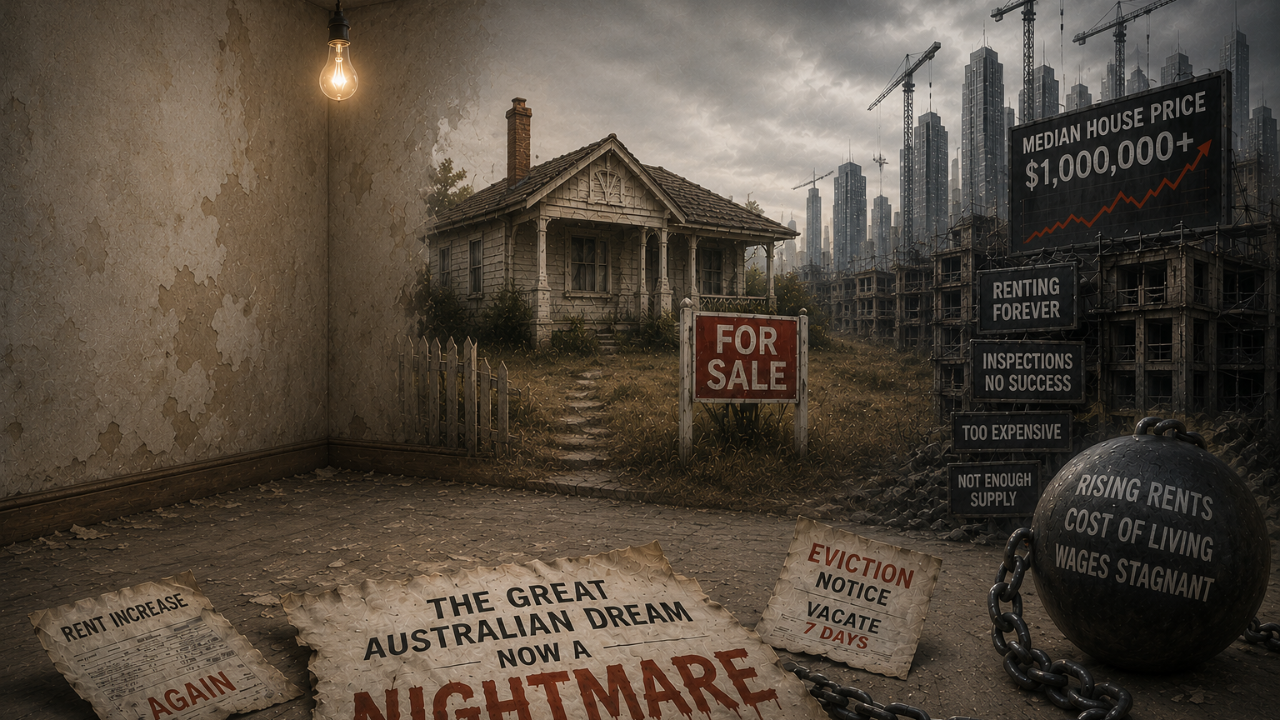
the dream of homeownership has turned into a nightmare. Yet the Government’s sole policy response has been to subsidise demand, build bureaucracy and avoid the reforms needed to increase supply. by freya leach.
First published in the MRC’s Watercooler newsletter. Sign up to our mailing list to receive Watercooler directly in your inbox.
Australia’s housing crisis is a national failure.
Since 2020, affordability has gotten worse. Interest rates have risen. House prices have continued to climb. Immigration has placed sustained pressure on demand. And new supply has failed to keep up. The median household can afford less than a quarter of homes on the market. The bottom third can afford just 3%.
Homeownership has become the great Australian nightmare. For baby boomers born between 1952 and 1956, 53% owned a home by age 25-29. For millennials born between 1992 and 1996, that figure had fallen to just 36.1%.
Housing security shapes family formation. When young Australians cannot buy a home, marriage and children are often delayed, as is the sense of ‘adulthood’. The financial consequences are obvious: the later people enter the housing market, the later they pay off their mortgage. Increasingly, Australians are carrying mortgage stress into retirement.This is more than an economic issue; it’s a challenge to our social fabric.
Yet the Government’s sole policy response has been to subsidise demand, build bureaucracy and avoid the reforms needed to increase supply.
Immigration is outpacing new housing supply
Since Labor came to office, around 1.4 million migrants have moved to Australia. Over the same period, only 558,000 homes were built. Assuming a generous 2.5 people per household, Australia needed more to build 575,000 dwellings just to accommodate those new arrivals. Even before accounting for natural population increase, there was already a shortfall of nearly 17,000 homes.
Australia’s natural population increase of about 373,000 people required another roughly 150,000 homes.
That leaves a total housing shortfall of more than 166,000 dwellings since Labor came to government.
You cannot run a mass migration program while failing to build enough homes and then act surprised when rents surge and prices rise.
Demand-driven schemes worsen the problem
Housing is governed by supply and demand. Labor seems determined to ignore both. Instead, the Albanese government has introduced a series of schemes supposedly designed to help first home buyers. In practice, these schemes risk making homes more expensive by pumping more money into a constrained market.
The expansion of the 5% deposit scheme is one example. The Help to Buy scheme is another.
Under Help to Buy, the government takes up to a 40% equity stake in new homes and 30% in existing homes, allowing buyers to purchase with as little as a 2% deposit. Over four years, up to 40,000 households are expected to access the scheme. On paper, this sounds great. In reality, it is another demand-side subsidy in a market already starved of supply.
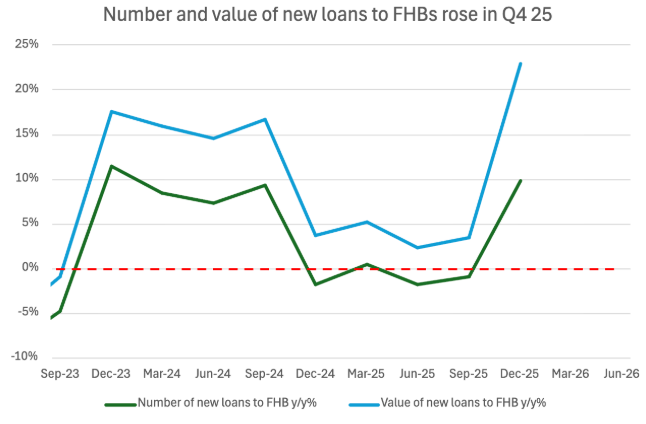
In the first quarter of the uncapped 5% deposit scheme, the value of new loans to first home buyers soared by 23% in Q4 2025 compared with the year prior. This is the perverse effect of housing subsidies; the value of new home loans outstripped the number, meaning first home buyers are simply having to borrow more to chase the same limited stock of housing.
Unbelievably, the 5% deposit scheme has also been accessed by nearly 50,000 non-citizens.
On supply, Labor’s record is even weaker
The only thing the federal government can claim credit for building is Housing Australia, an incompetent and dysfunctional bureaucracy. While staff turnover was 26% last year, the board concerned itself with the state of the furniture.
“The Chair noted that lumbar supporting (grey) chairs should be utilised as a preference in Housing Australia meeting rooms for meeting attendees’ comfort and better back health for longer meetings,” said minutes of a board meeting obtained by the AFR.
We also have to ask whether taxpayers are getting value for money. The Housing Australia Future Fund (HAFF) is a $10 billion investment fund set up by the federal government, with its returns used to subsidise new affordable housing. Its target is to deliver 30,000 new homes over five years. The average cost of construction for a new dwelling is around $500,000, yet in Round 1 of the HAFF, 8,246 homes were funded at a cost of $6.1bn. Each unit of affordable housing cost taxpayers over $800,000. This raises serious questions about Housing Australia’s transparency, performance and value for money.
Then there is Build to Rent. Around $3bn of super capital has been invested in build-to-rent projects. If superannuation is going to be used to support housing, the obvious question is why Australians cannot use more of their own super to buy their own home. Why should the aspiration for young Australians be permanent renting from corporate landlords, funded by their own superannuation?
Increased red tape slows down completion rates
Red tape is pushing up building costs and choking supply. The National Construction Code has ballooned from 200 pages in the late 1980s to more than 2,000 pages today. Are our buildings 10x better than they were 30 years ago? The Master Builders Association has warned that high-density developments take an extra year to build compared to a decade ago.
Labor promised to accelerate housing approvals by reforming the Environment Protection and Biodiversity Conservation Act (EPBC). But the recent Senate productivity hearings revealed nearly 100,000 homes are stalled because of green tape in the EPBC.
Despite tens of billions of dollars being poured into housing, completions have fallen under Labor. Around 20,000 fewer homes are being built each year. To reach Labor’s target of 1.2 million homes by mid-2029, they would need to build 60,000 homes per quarter. Instead, around 44,000 homes are being built. That’s a shortfall of nearly 100,000 homes since the Housing Accord was introduced in July 2024.
Taxing supply only creates uncertainty
Meanwhile, the government is flirting with higher taxes on property investors. This is exactly the wrong direction. You cannot tax your way out of a housing shortage. Worse still, Labor will try to convince young Australians that their planned housing tax is aimed at addressing intergenerational inequality.
Higher taxes will not build more homes or reduce construction costs. They will not make planning approvals faster or connect utilities sooner. This move will simply make investment more uncertain at the very time Australia needs more supply.
A government cannot bring in record numbers of people, fail to build enough homes, subsidise demand, tax supply and then claim to be solving the crisis. The Government has given Australians new slogans, onerous schemes and expensive subsidies. None of it is moving the dial; affordability has worsened.
Restoring the dream of homeownership requires common sense. Lower building costs and accelerate approvals by slashing red tape and rein in demand by running an immigration program consistent with our capacity to deliver sufficient housing. And reign in Australia's construction union, whose militancy adds 30% to construction costs.
Until all of this happens, the dream of home ownership will continue to recede, and with it, the promise of our intergenerational contract; that each generation of Australians should be better off than the one before.
